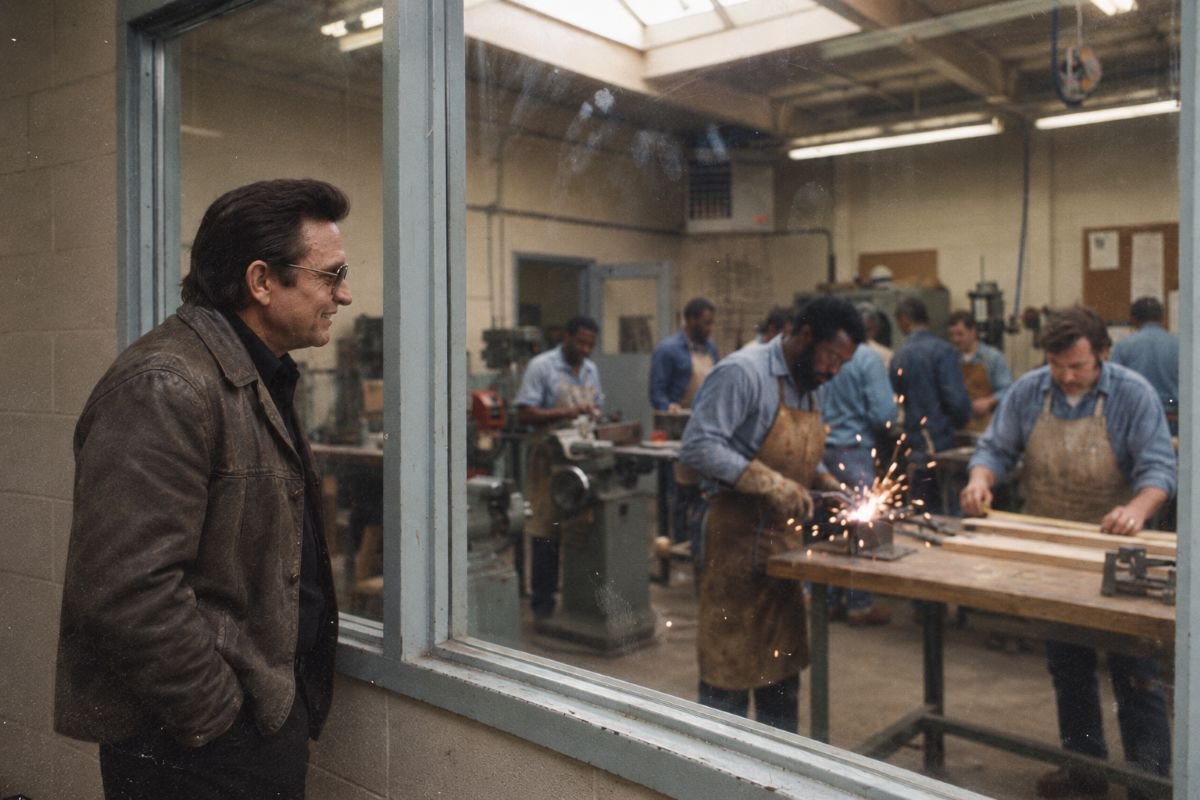
THE OTHER SIDE OF JOHNNY CASH: THE MAN WHO BELIEVED FORMER PRISONERS DESERVED A SECOND CHANCE — A POWERFUL STORY OF DIGNITY, COMPASSION, AND HOPE
When people hear the name Johnny Cash, they often think of the deep voice, the black clothes, the prison songs, and the unmistakable presence of one of America’s greatest musical figures. But there was another side to Cash that deserves just as much attention: his longstanding concern for people trying to rebuild their lives after prison.
Cash’s connection with prisoners was not something he developed after becoming famous. It was woven into his music and public life for decades.
His famous song “Folsom Prison Blues” was released in 1955, and years later he performed historic concerts at Folsom Prison and San Quentin. Those performances were important not only because of the music, but because Cash treated incarcerated people as an audience whose stories deserved to be heard.
He understood something that many people outside prison did not always understand.
A person can make a serious mistake and still hope for a different future.
That belief became an important part of Cash’s public identity.
His prison performances introduced millions of listeners to a side of American life that was rarely presented so directly in popular music. Cash sang about prisoners, regret, loneliness, responsibility, and the possibility of redemption.
But singing about second chances was one thing.
Helping people find one was another.
Throughout his career, Cash expressed support for rehabilitation and better treatment of prisoners. He spoke publicly about the challenges facing incarcerated people and those attempting to return to society after serving their sentences.
For someone leaving prison, freedom does not necessarily mean an easy new beginning.
Finding housing can be difficult.
Reconnecting with family can take time.
And perhaps most importantly, finding stable employment can be extremely challenging.
A criminal record can close doors before a person even has an opportunity to explain who they have become.
Cash understood the importance of work.
He had grown up in a poor farming family during the Great Depression. His childhood in Dyess, Arkansas, taught him the value of labor, responsibility, and perseverance. Before becoming a famous musician, he had experienced ordinary working life himself.
That background helped shape his sympathy for people who were struggling to find stability.
Stories have circulated about Cash using money from his performances to support employment or training opportunities for former prisoners, and some accounts describe him as helping people obtain work through businesses connected to him.
However, specific claims that he personally established a formal job-training program in Nashville using concert earnings should be presented cautiously unless supported by reliable historical documentation.
What is firmly consistent with the historical record is Cash’s longstanding advocacy for prisoners and rehabilitation.
His actions at Folsom and San Quentin demonstrated that his interest was not simply a marketing strategy.
Cash repeatedly returned to the subject.
He visited prisons.
He performed for incarcerated audiences.
He spoke about prison reform.
And he used his enormous public platform to encourage people to think about what happened to prisoners after their sentences ended.
That final question was crucial.
What happens when someone walks through the prison gates?
Does society simply expect that person to become successful without giving them a realistic opportunity?
Or should there be a path toward work, responsibility, and reintegration?
Cash’s music often suggested that people should not be permanently defined by their worst moments.
That philosophy appeared in many of his songs.
His characters were frequently imperfect. They made mistakes. They experienced loss. They faced consequences. But Cash rarely treated them as if their stories ended there.
There was usually another possibility.
Another road.
Another chance.
That is why his relationship with former prisoners is such an important part of his legacy.
Cash understood that dignity often begins with being given responsibility.
A job is more than a paycheck.
For someone rebuilding life after incarceration, employment can provide structure, independence, confidence, and a sense of belonging. It can also give a person a reason to believe that the future does not have to be a continuation of the past.
Cash could not solve those problems for everyone.
But he could use his influence to start conversations about them.
And he did.
His willingness to perform inside prisons was itself a powerful statement. At a time when many entertainers avoided such environments, Cash deliberately entered them.
He did not arrive simply to lecture.
He arrived to listen and perform.
The response from prisoners at Folsom became legendary.
Their voices, laughter, applause, and reactions became part of the recording itself. The resulting At Folsom Prison album transformed Cash’s career and became one of the most important live recordings in American music.
But the album’s significance went beyond commercial success.
It reminded the public that prisoners were not merely numbers or headlines.
They were people.
They had memories.
They had families.
They had hopes.
And some of them wanted desperately to change.
One of the most remarkable examples was Glen Sherley, the Folsom inmate who wrote “Greystone Chapel.” Cash heard the song, performed it during the prison concert, and later supported Sherley’s attempt to establish himself as a songwriter after his release.
Sherley’s story ultimately ended tragically, but Cash’s involvement demonstrated the complicated reality of offering someone a second chance.
Opening a door does not guarantee what happens afterward.
A person may still face enormous obstacles.
But without that open door, there may be no opportunity at all.
That distinction is central to understanding Cash’s philosophy.
He did not present redemption as something easy.
He presented it as possible.
And sometimes, possibility is the first thing a person needs.
Johnny Cash’s own life contained enough difficult chapters to make that message believable. He had experienced addiction, personal struggles, professional setbacks, and periods when his future was uncertain.
He knew what it meant to fall.
He also knew what it meant to get back up.
That personal history may have helped explain why he showed such interest in people who were trying to rebuild their lives.
His message was not that mistakes did not matter.
It was that a mistake should not necessarily become the final chapter of a person’s story.
That idea remains relevant today.
Former prisoners often face significant barriers when returning to their communities. Employment, education, housing, and social acceptance can all affect whether someone is able to build a stable future.
Cash’s legacy offers a simple human perspective on that problem.
If someone is willing to work, learn, take responsibility, and change, should society leave every door permanently closed?
Johnny Cash repeatedly used his music to suggest that the answer should not be so simple.
His greatest contribution may not have been any single program or financial gift.
It may have been his ability to make people care about individuals whom society had already stopped seeing.
That was the other side of Johnny Cash.
Behind the famous performer was a man deeply interested in stories of hardship and redemption.
Behind the black suit was an artist who believed that people deserved to be seen as more than their mistakes.
And behind the prison concerts was a message that remained consistent throughout his career:
A person’s past can explain where they have been, but it does not always have to determine where they can go next.
Johnny Cash spent a lifetime singing about second chances.
And through his attention to prisoners and people struggling to rebuild their lives, he helped keep one powerful idea alive:
Sometimes compassion begins with something as simple as giving someone the opportunity to work, contribute, and start again.
VIDEO