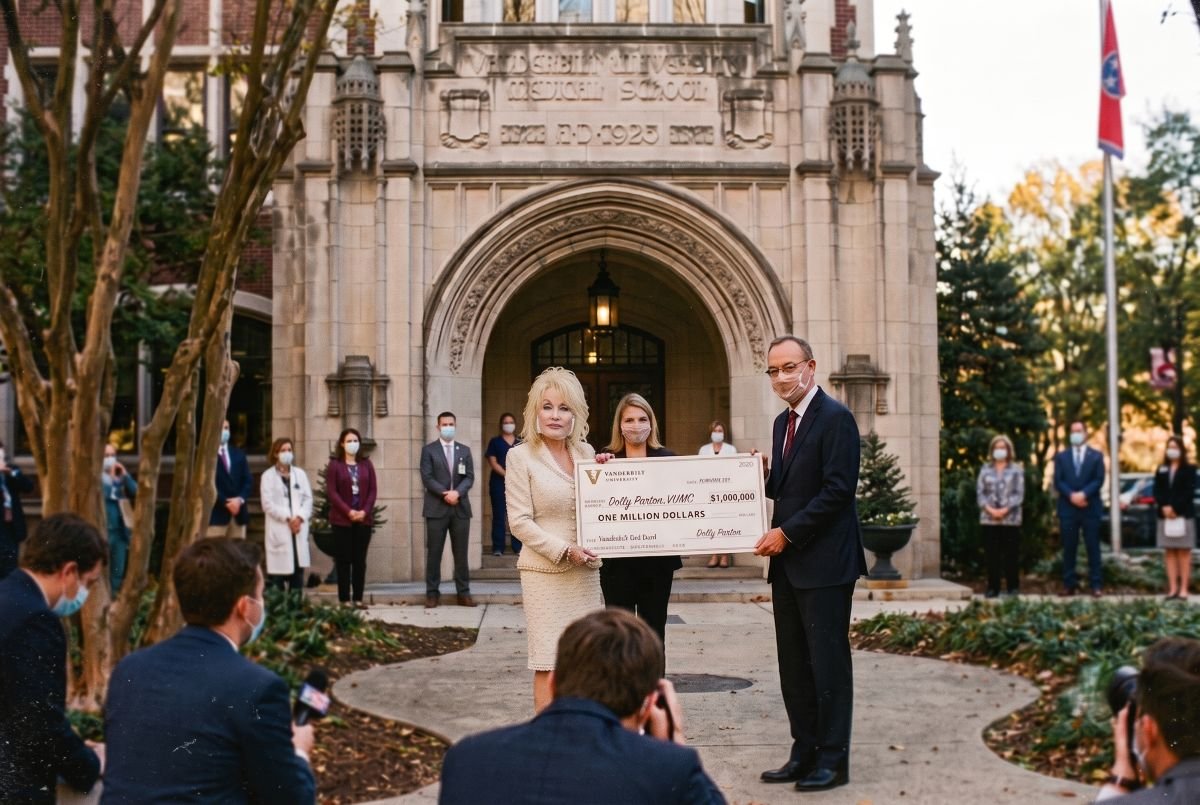
THE EXTRAORDINARY GIFT THAT MADE HEADLINES: DOLLY PARTON AND THE MILLION-DOLLAR DONATION THAT HELPED COVID-19 VACCINE RESEARCH
When the world was plunged into uncertainty in the spring of 2020, few people could have imagined how quickly an ordinary act of generosity could become part of one of the most important scientific stories of the decade. Hospitals were overwhelmed, families were separated, businesses were closing, and researchers were racing against time to understand a new virus that had changed everyday life across the globe.
Then came an unexpected name in the middle of the scientific effort: Dolly Parton.
Known around the world as a country music legend, songwriter, actress, author, and philanthropist, Parton made a $1 million donation to Vanderbilt University Medical Center in April 2020 to support COVID-19 research. What followed would eventually connect her name to research that contributed to the development of the Moderna COVID-19 vaccine.
The story captured public attention because it seemed to bring together two worlds that rarely meet so dramatically: country music and cutting-edge medical research.
But the real story is more meaningful than a simple headline suggesting that a celebrity somehow created a vaccine.
Parton’s contribution was not a personal investment in developing a vaccine under her own direction. Instead, her donation supported scientific research at Vanderbilt University Medical Center, where researchers were working to understand and combat COVID-19 during the earliest and most uncertain months of the pandemic.
Among the researchers connected to this work was Dr. James Crowe Jr., whose team at Vanderbilt was involved in research that identified and studied antibodies capable of responding to the coronavirus. Early research from the Vanderbilt team contributed to work that later became relevant to Moderna’s vaccine program.
That connection gave Parton’s donation a remarkable place in the story of the pandemic.
It also revealed something important about philanthropy: sometimes the person writing the check is not the person standing in the laboratory. The contribution may instead provide researchers with the resources, time, equipment, and freedom necessary to pursue discoveries that can eventually reach millions of people.
Parton’s decision came during a period when the future was anything but certain.
In early 2020, scientists were working under extraordinary pressure. The virus was spreading rapidly, medical systems were struggling, and there was no established vaccine available to protect the public. Research institutions needed financial support to move quickly.
Parton’s gift arrived at precisely that moment.
Her name naturally attracted attention, but the significance of the donation went beyond publicity. One million dollars represented a substantial commitment to scientific research at a time when the world desperately needed answers.
The story became even more fascinating after Moderna’s vaccine advanced through development and clinical testing.
As the vaccine became one of the major COVID-19 vaccines used around the world, Parton’s name was repeatedly mentioned because of the connection between her Vanderbilt donation and the research that helped support early vaccine-related work.
That association eventually led to a memorable moment in 2021, when Parton received the Moderna COVID-19 vaccine after vaccines became available to the public. During the vaccination, she famously adapted the lyrics of her song “Jolene” into the playful phrase “Vaccine, vaccine”, turning a serious public-health moment into something unmistakably Dolly.
Yet there is an important distinction that is sometimes lost in retellings of the story.
Parton was not publicly identified as a participant in Moderna’s clinical trials, nor did she personally develop the vaccine. Her contribution was philanthropic. Her $1 million donation supported research at Vanderbilt, and researchers there contributed to scientific work that became part of the broader effort surrounding COVID-19 vaccines.
That distinction does not make her contribution less interesting. In many ways, it makes the story more revealing.
Scientific breakthroughs are rarely the result of one person working alone. They emerge from researchers, doctors, universities, laboratories, funding, technology, clinical testing, manufacturing, and countless hours of work. Behind every major scientific achievement are often smaller decisions that helped make the larger effort possible.
Parton’s donation became one of those decisions.
For a woman whose career had been built on music, storytelling, and connecting with ordinary people, the moment represented a striking expansion of her influence. Her generosity demonstrated how a public figure can use personal resources to support work far removed from the entertainment industry.
And perhaps that is why the story resonated so strongly.
Dolly Parton did not need to become a scientist to contribute to science. She did not need to enter a laboratory or claim credit for discoveries made by researchers. Instead, she used something she had possessed for decades: the ability and willingness to give.
Her $1 million contribution became part of a much larger story about humanity’s response to an unprecedented crisis.
Years later, the details still matter. The donation did not single-handedly create Moderna’s vaccine, and Parton was not the scientist behind it. But her gift helped support COVID-19 research at Vanderbilt during a critical period, while Vanderbilt researchers contributed to early scientific work connected to the broader vaccine effort.
In the end, the most remarkable part of the story may not be the celebrity attached to it.
It may be the simple idea behind the gift: when the world was searching for hope, Dolly Parton chose to help fund the people searching for answers.
And that decision allowed a country music icon’s generosity to become part of a scientific story that reached far beyond the stage, the recording studio, and the world of entertainment.