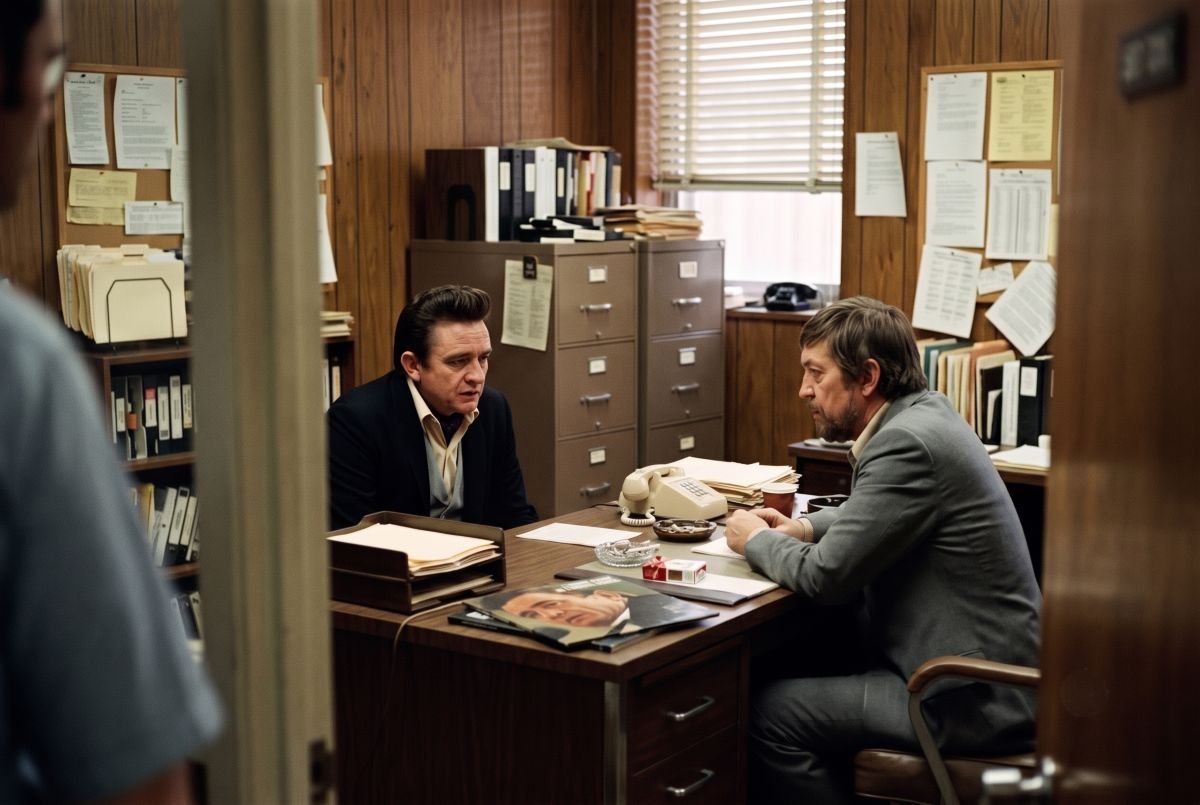
THE NIGHT THAT CHANGED JOHNNY CASH’S CAREER: AFTER YEARS OF ASKING TO RECORD INSIDE A PRISON, ONE BOLD DECISION LED TO “AT FOLSOM PRISON”
By the middle of the 1960s, Johnny Cash was no longer at the unstoppable peak he had once enjoyed. His music remained important, but his career had entered a difficult period, while personal struggles and substance dependence were taking a serious toll. Somewhere in the middle of that uncertainty, Cash continued pursuing an unusual idea: he wanted to perform inside a prison and record the concert live.
It was an idea that had followed him for years.
Cash had always felt a particular connection with prisoners. His 1955 hit “Folsom Prison Blues” had helped establish that connection, and he believed that audiences behind prison walls could understand his music in a way that few others could.
He repeatedly expressed interest in performing at Folsom Prison in California.
For years, however, the idea remained difficult to realize.
There were concerns about security, logistics, recording equipment, and whether a major record company would consider the project worthwhile. A prison was hardly the conventional setting for a commercial recording. Most artists were looking for theaters, concert halls, or television studios.
Cash wanted something entirely different.
He wanted the audience to be made up of people who actually understood the world described in his songs.
Then Bob Johnston entered the picture.
Johnston had become an important figure in Cash’s recording career, and he understood that Cash needed more than another conventional studio session. The singer needed an environment in which his personality, storytelling ability, and connection with an audience could come alive.
According to later accounts, Johnston became convinced that a prison concert could be exactly what Cash needed.
The famous story surrounding the decision has sometimes been summarized with the dramatic line, “Let Cash record in prison, or he’ll die.” That wording should be treated as part of the colorful history surrounding the project rather than a precisely documented quotation unless supported by a primary source.
But the underlying situation was serious.
Cash’s career was struggling.
His personal life had become increasingly difficult.
And something needed to change.
Rather than trying to make Cash fit into a conventional recording environment, Johnston helped create an opportunity that played directly to the singer’s strengths.
The location would be Folsom Prison.
The date was January 13, 1968.
The stakes were enormous.
Cash arrived at Folsom with a band that included Luther Perkins and Marshall Grant, along with other musicians who understood the importance of the occasion. The performance was not going to be polished like a studio recording.
It was going to be live.
And the audience would make itself heard.
When Cash walked onto the stage, the response from the prisoners was immediate. The atmosphere was energetic, unpredictable, and completely different from the controlled environment of a recording studio.
Cash seemed to thrive on it.
He performed “Folsom Prison Blues”, and the reaction was tremendous. The audience laughed, shouted, applauded, and responded to the songs with an intensity that became an essential part of the recording.
For Cash, this was not simply a performance.
It was a conversation.
He understood the people in front of him, and they understood the stories he was telling.
The concert also included songs that revealed a broader side of Cash’s relationship with prisoners. One of the most remarkable was “Greystone Chapel,” written by Folsom inmate Glen Sherley.
Cash had heard the song shortly before the concert and decided to perform it. The moment gave Sherley an opportunity that would have been almost unimaginable: hearing his own composition performed by Johnny Cash in the prison where he was incarcerated.
That scene captured something essential about the entire project.
The recording was not simply about Johnny Cash.
It was about people who rarely had a public voice suddenly becoming part of a historic musical event.
When At Folsom Prison was released in May 1968, listeners immediately recognized that something unusual had happened.
The album felt raw.
It felt spontaneous.
It felt human.
The audience was not hidden in the background. Their reactions became part of the music itself.
The result was a major commercial success. At Folsom Prison reached No. 1 on the Billboard country album chart, helping restore Cash’s position at the center of American music.
For an artist whose career had been struggling, the timing was extraordinary.
The album changed how the public saw him.
Cash was no longer simply the singer of older hits. He appeared renewed, confident, and completely connected with his audience. The prison setting gave him an authenticity that conventional studio recordings could not reproduce.
His career gained new momentum.
Television opportunities expanded.
In 1969, The Johnny Cash Show brought his music and personality to a national television audience.
The Folsom recording had become far more than a risky experiment.
It was a career-defining moment.
Yet the success of the album should not obscure the work that came before it.
Cash had been performing for years.
He had spent years developing his distinctive sound.
He had already written and recorded songs that established his connection with working people, prisoners, soldiers, and outsiders.
And he had spent years asking for the opportunity to perform at Folsom.
The concert succeeded because the right idea finally met the right circumstances.
Bob Johnston’s role was significant because he was willing to embrace a project that could easily have failed. Recording inside a prison involved obvious risks. There was no guarantee that the audience would cooperate, that the sound would be usable, or that the resulting album would appeal to the public.
But the gamble worked.
In fact, it produced one of the most important live albums in country music history.
The deeper story is therefore not simply that a producer “saved” Johnny Cash in one night.
It is the story of an artist who had reached a difficult point, a producer willing to take a chance, and an unusual audience that gave Cash exactly the environment in which his artistry could flourish.
Folsom became the setting where those elements came together.
The prison walls that might have seemed like a limitation instead became part of the album’s identity.
The prisoners who might have been treated as background figures became an essential part of the performance.
And Johnny Cash, standing at the center of it all, rediscovered the extraordinary connection that had made him special.
The success of At Folsom Prison would influence Cash’s career for years to come. It also strengthened his reputation as an artist willing to stand with people society often overlooked.
Most importantly, it demonstrated that great music does not always emerge from perfect circumstances.
Sometimes it comes from uncertainty.
Sometimes it comes from taking a risk.
And sometimes, the most unlikely room can become the place where an artist finds his voice again.
For Johnny Cash, that room was inside Folsom Prison.
What began as a long-held idea became a daring experiment.
The experiment became a historic concert.
The concert became a landmark album.
And the landmark album became one of the greatest turning points in Johnny Cash’s extraordinary career.
The prison doors eventually closed behind him, but the music created inside those walls traveled around the world—and decades later, the raw energy of that January afternoon still sounds remarkably alive.