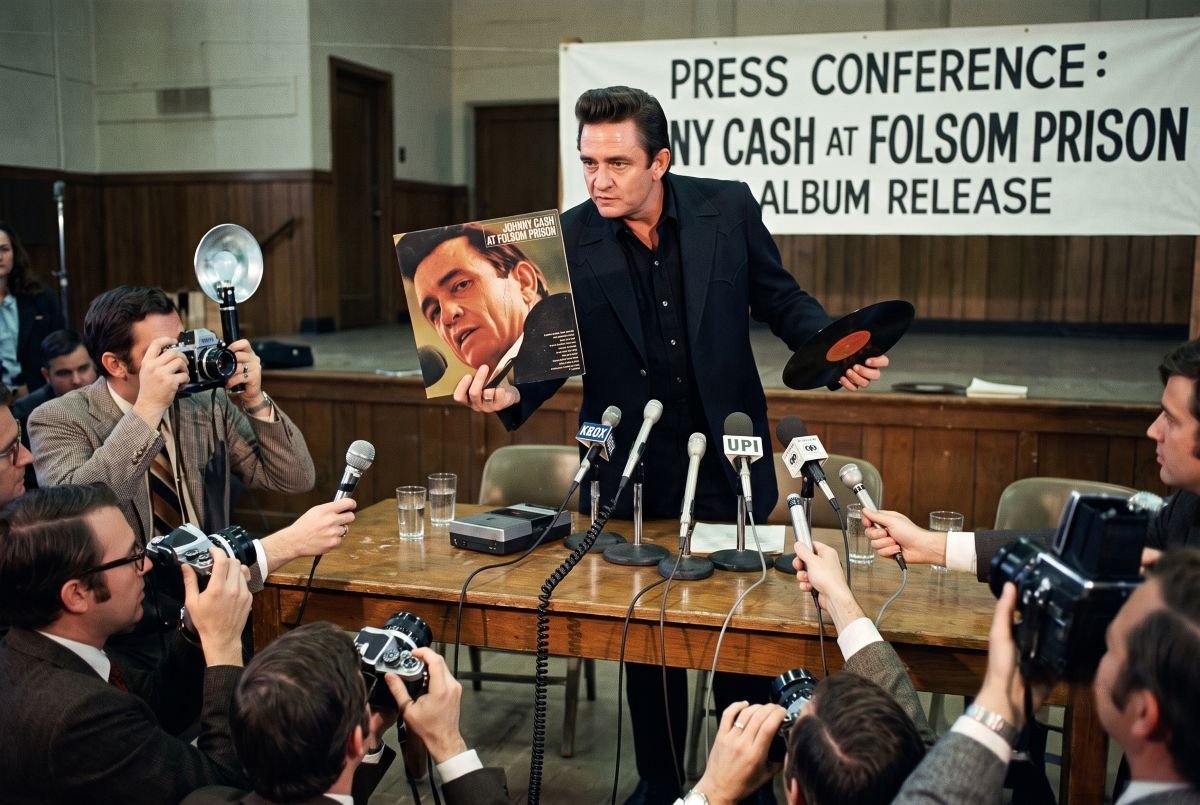
THE EXTRAORDINARY COMEBACK: JOHNNY CASH AT THE LOWEST POINT OF HIS CAREER, HIS STRUGGLES WITH ADDICTION, AND THE LIVE PRISON ALBUM THAT CHANGED EVERYTHING — HOW “AT FOLSOM PRISON” REIGNITED HIS CAREER AND TURNED A PAINFUL CHAPTER INTO ONE OF THE MOST POWERFUL MOMENTS IN MUSIC HISTORY
By the mid-1960s, Johnny Cash was facing one of the most difficult periods of his extraordinary life. The man who had once seemed almost unstoppable was struggling with substance dependence, an exhausting touring schedule, and personal difficulties that threatened both his health and his career.
From the outside, Cash was still a major country music star.
Behind the scenes, however, his life had become increasingly unstable.
For years, Cash had relied on prescription drugs, particularly stimulants and sedatives, as the demands of his career intensified. Constant travel, long performances, and the pressures of fame created an environment in which his dependence became increasingly difficult to control.
His personal life suffered.
His professional future became uncertain.
And Cash himself later acknowledged how destructive that period had been.
Yet just when his career appeared to be moving in the wrong direction, an extraordinary opportunity emerged—one that would take him inside Folsom State Prison.
The idea of performing for prisoners was not entirely new to Cash.
His connection with prison audiences stretched back years. His famous 1955 song “Folsom Prison Blues” had been inspired by the film Inside the Walls of Folsom Prison, and Cash had developed a fascination with the people living behind prison walls.
He believed prisoners deserved to be treated as human beings.
More importantly, he understood them.
His own struggles had given him an unusual perspective on people trying to escape difficult circumstances.
In 1967, a crucial change began taking place in Cash’s life.
With the support of June Carter, his family, friends, and people around him, Cash began confronting his dependence. June, who would later become his wife, played an important role in encouraging him toward stability and recovery.
Cash’s journey was not simple or immediate, but he began rebuilding his life.
Then came the opportunity that would become one of the defining moments of his career.
On January 13, 1968, Johnny Cash and his band arrived at Folsom Prison in California.
The atmosphere was unlike an ordinary concert.
There was no glamorous theater.
No polished television studio.
No comfortable separation between performer and audience.
Instead, Cash stood before hundreds of incarcerated men, many of whom had personal experiences that closely resembled the stories he had been singing about for years.
When Cash walked onto the stage, the response was immediate.
The audience knew who he was.
But Cash also knew exactly who they were.
He understood that these men did not need to be treated like a distant audience. They wanted to be recognized.
Cash’s performance was energetic, direct, and remarkably human.
He performed “Folsom Prison Blues,” along with songs such as “Cocaine Blues,” “I Got Stripes,” and other selections. He also performed songs written by prisoners, including “Greystone Chapel,” written by inmate Glen Sherley.
That final song carried a remarkable story of its own.
Sherley had written “Greystone Chapel” while incarcerated at Folsom. Cash heard the song shortly before the concert and decided to perform it.
Suddenly, a songwriter who was virtually unknown outside prison was hearing his own work performed by one of the biggest stars in American music.
It was an unforgettable moment.
The concert was recorded, and the resulting album, At Folsom Prison, was released in May 1968.
What happened next surprised almost everyone.
The album became a major commercial and critical success.
It reached No. 1 on the Billboard country album chart and helped restore Cash’s position as a major recording artist. The live recording captured something that polished studio albums often could not: the raw relationship between Cash and his audience.
You could hear the prisoners reacting.
You could hear Cash responding.
There was laughter, applause, shouting, and an unmistakable sense that something genuine was happening.
The album did not sound manufactured.
It sounded alive.
That authenticity became one of its greatest strengths.
The success of At Folsom Prison effectively changed the narrative surrounding Cash. Instead of being remembered primarily as an artist struggling through a difficult period, he once again became one of the most compelling figures in American music.
Television opportunities followed.
His career gained momentum.
And in 1969, he received an even larger platform with The Johnny Cash Show, a network television program that introduced him to an enormous audience.
The Folsom concert had not simply produced a successful album.
It had helped reconnect Cash with the qualities that had made him special in the first place.
He was an artist who could stand in front of people from very different backgrounds and make them feel that their experiences mattered.
His struggles also became part of the story.
Cash never presented himself as perfect. His music frequently explored mistakes, regret, redemption, loneliness, faith, and second chances. After surviving one of the darkest periods of his life, those themes carried an even greater sense of authenticity.
That is why At Folsom Prison remains so important.
It was more than a live recording.
It was a moment of renewal.
Cash had been struggling with addiction and uncertainty. His career needed direction. His personal life had reached a dangerous point. Yet instead of retreating completely, he found a way to reconnect with his audience.
And that connection helped revive his career.
The story also demonstrates why Johnny Cash’s relationship with prisoners became such an important part of his legacy.
He did not view incarceration as the end of a person’s story.
He believed people could change.
That belief was reflected in his songs and in his willingness to perform for people whom many others might have ignored.
The irony is striking.
A concert inside a prison became one of the events that helped free Johnny Cash from the downward direction of his own career.
He entered Folsom carrying the weight of years of struggle.
He left having created something extraordinary.
The album that followed captured a performer completely connected with his audience. It reminded the public that Johnny Cash was not simply a country singer with a deep voice. He was a storyteller who understood the complicated lives of ordinary people.
Years later, At Folsom Prison would be recognized as one of the most important live albums in American music.
Its impact extended far beyond sales figures.
It changed how audiences understood Cash.
It strengthened his career.
And it demonstrated the extraordinary power of honesty and human connection.
Johnny Cash’s comeback did not erase the difficult years that came before it. His struggles remained part of his story. Recovery was not a single moment but an ongoing process, and Cash would face additional challenges throughout his life.
But Folsom represented a turning point.
It showed what could happen when a troubled artist found his voice again.
And perhaps that is why the album still feels so powerful today.
Inside a prison, Johnny Cash found an audience that understood his songs.
In return, he gave those prisoners something they rarely received from the outside world: attention, respect, and a voice.
The performance became legendary.
The album became a landmark.
And Johnny Cash emerged from one of the most difficult chapters of his life with his career stronger than before.
Sometimes a comeback does not begin when everything is going well.
Sometimes it begins at the exact moment when a person decides to face the past, step forward, and perform one more time.
For Johnny Cash, that step led through the gates of Folsom Prison—and into music history.