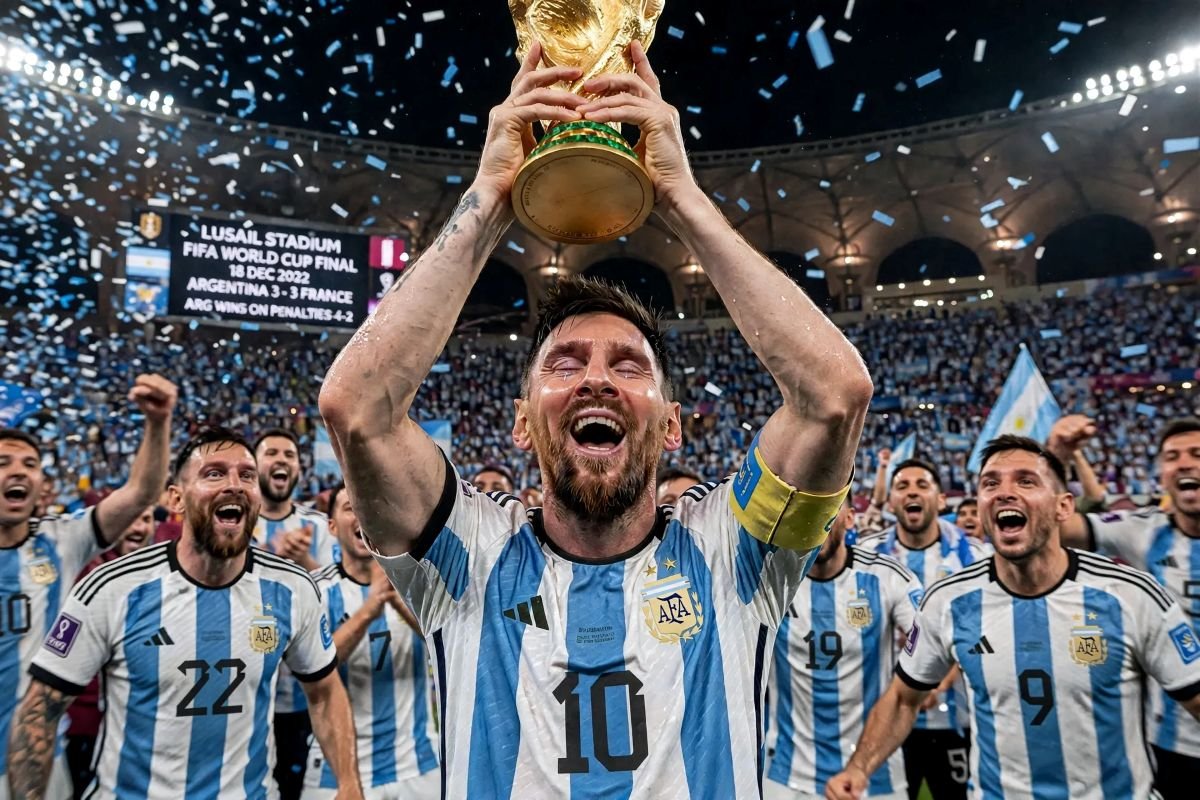
DECEMBER 18, 2022: THE NIGHT LIONEL MESSI FINALLY FULFILLED HIS WORLD CUP DREAM AFTER YEARS OF DISAPPOINTMENT
For years, Lionel Messi had achieved almost everything a footballer could dream of. He had won domestic championships, Champions League titles, individual awards, and countless records with Barcelona. Yet, one major achievement remained missing from his extraordinary career: the FIFA World Cup.
His journey with Argentina had included several painful disappointments. He lost the 2014 World Cup final against Germany and suffered defeats in the 2015 and 2016 Copa América finals against Chile. Although he continued to perform at an exceptional level, the absence of an international championship became a frequent subject of criticism.
Then came December 18, 2022.
At Lusail Stadium in Qatar, Argentina defeated France in one of the most dramatic World Cup finals ever played. After years of waiting, Messi finally lifted the trophy that had remained beyond his reach.
It was a defining moment in his career and an unforgettable day for millions of football supporters.
Years of Disappointment Before Qatar
Messi’s international journey was filled with both extraordinary performances and difficult setbacks.
At the 2014 World Cup in Brazil, Argentina reached the final against Germany. The match remained goalless during normal time, but Mario Götze scored in extra time to give Germany a 1–0 victory.
Messi received the Golden Ball as the tournament’s best player, but Argentina returned home without the championship.
The disappointment continued at the 2015 Copa América. Argentina reached the final against Chile, but the match ended goalless after extra time, and Chile won the penalty shootout.
One year later, the two teams met again in the 2016 Copa América Centenario final. Once more, the match ended 0–0 after extra time, and Chile won on penalties.
Following that defeat, Messi announced his retirement from international football. However, he later reconsidered and returned to represent Argentina.
His decision proved significant.
In 2021, Argentina won the Copa América by defeating Brazil 1–0 at the Maracanã Stadium. Ángel Di María scored the decisive goal, while Messi finally celebrated his first major senior international trophy.
That victory ended a long wait for international success, but the World Cup remained the ultimate ambition.
The 2022 World Cup: A Difficult Beginning and an Extraordinary Journey
Argentina arrived in Qatar among the tournament favourites, but their campaign began with an unexpected setback.
On November 22, 2022, Argentina lost 2–1 to Saudi Arabia despite taking an early lead through Messi’s penalty. The result shocked supporters and immediately placed pressure on the team.
Argentina responded with a 2–0 victory over Mexico, in which Messi scored a crucial goal. They then defeated Poland 2–0 to secure qualification for the knockout stages.
From that point onward, Messi and his teammates continued their progress.
Argentina defeated Australia 2–1 in the round of 16, with Messi scoring his first goal in a World Cup knockout match.
The quarter-final against the Netherlands proved much more difficult. Argentina led 2–0 before the Dutch equalized in the closing stages. The match went to penalties, where Argentina eventually won 4–3.
In the semi-final, Argentina produced a convincing 3–0 victory over Croatia. Messi scored from the penalty spot, while Julián Álvarez added two goals.
Argentina had reached the final, where France, the defending champions, were waiting.
The Final Against France: A Match That Had Everything
The December 18 final became one of the most memorable matches in World Cup history.
Argentina started strongly, and Messi opened the scoring with a penalty in the 23rd minute. Ángel Di María doubled the advantage in the 36th minute after a well-executed attacking move.
For much of the first half, Argentina controlled the match.
However, France responded dramatically. Kylian Mbappé scored a penalty in the 80th minute and equalized with a volley just one minute later.
The score was 2–2, and the final entered extra time.
In the 108th minute, Messi scored again after a rebound, putting Argentina ahead 3–2. But Mbappé completed his hat-trick by converting another penalty in the 118th minute.
With the score tied at 3–3, neither team could find another goal.
The World Cup final would be decided by a penalty shootout.
Argentina won 4–2, with Gonzalo Montiel scoring the decisive penalty.
As the final whistle confirmed Argentina’s victory, Messi celebrated with his teammates before receiving the World Cup trophy.
After years of disappointment, he had finally achieved the greatest international success of his career.
Why the World Cup Changed Messi’s Legacy
Before Qatar 2022, Messi was already widely considered one of the greatest footballers of all time. His achievements at Barcelona had established an extraordinary standard of individual and team success.
However, the absence of a World Cup title remained an important part of discussions about his international career.
Winning in Qatar did not end every debate about football’s greatest player. Comparisons between Messi, Cristiano Ronaldo, Pelé, and Diego Maradona will continue for generations.
Nevertheless, the World Cup added a major achievement to Messi’s already remarkable legacy.
He demonstrated his importance to Argentina throughout the tournament, contributing goals, assists, creativity, and leadership during crucial matches.
He also received the Golden Ball as the best player of the 2022 World Cup, becoming the first footballer to win the award twice after previously receiving it in 2014.
For Argentina, the victory ended a 36-year wait for another men’s World Cup championship. For Messi, it completed a chapter that had defined much of his international career.
Lionel Messi’s World Cup 2022 Statistics
| Category | Achievement | Detail |
|---|---|---|
| Matches Played | 7 | Started all seven matches |
| Goals Scored | 7 | Including two in the final |
| Assists | 3 | Official tournament records |
| Golden Ball | 1 | Best player of the tournament |
| Final Date | December 18, 2022 | Lusail Stadium, Qatar |
| Final Result | 3–3 | Argentina won 4–2 on penalties |
Source: FIFA World Cup Qatar 2022 official tournament records.
One of Messi’s most remarkable achievements was scoring in every knockout round of the competition: the round of 16, quarter-final, semi-final, and final.
He became the first player to score in every round of a single men’s World Cup tournament.
These statistics help explain his importance to Argentina’s championship campaign. His contribution was not limited to the final; he played a decisive role throughout the entire tournament.
My Perspective
I watched the final with my family, and when France scored twice in quick succession to make it 2–2, I genuinely thought Messi might experience another painful World Cup defeat. When Argentina finally won the penalty shootout, I felt overwhelmed because I had followed his international career through the disappointments of previous tournaments and had waited years to see him lift that trophy. For me, December 18, 2022, was not simply the night Messi won the World Cup; it was the moment a long and remarkable football journey reached one of its greatest achievements.
What do you remember most about that final? Was it Messi’s two goals, Mbappé’s extraordinary hat-trick, or the moment Argentina finally won the penalty shootout? I would love to hear your memories of a match that gave football fans around the world something they will never forget.