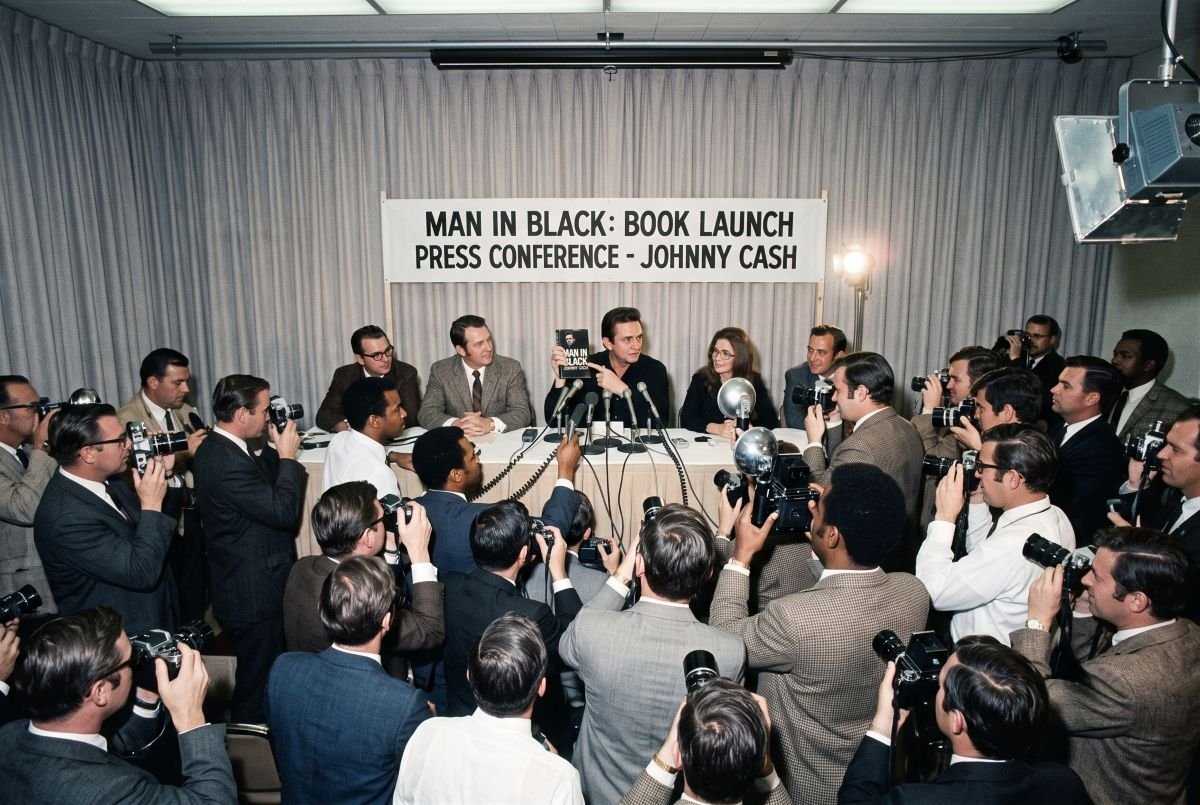
THE UNTOLD TRUTH BEHIND JOHNNY CASH’S “MAN IN BLACK”: THE AUTOBIOGRAPHY THAT REVEALED THE MAN BEHIND THE LEGEND — HIS MISTAKES, STRUGGLES, REGRETS, AND THE DARK CHAPTERS HE CARRIED BEHIND THE SPOTLIGHT
Johnny Cash spent much of his life being watched.
Millions knew the deep voice. They knew the black clothes, the prison songs, the television appearances, and the unforgettable performances. They knew the public image of The Man in Black.
But very few people could truly know the man behind that image.
In 1975, Cash published his autobiography, Man in Black: His Own Story in His Own Words, offering readers an unusually personal look at the life behind the legend. The book did not present a perfectly polished celebrity biography. Instead, Cash reflected on his childhood, his rise to fame, his family, his faith, his mistakes, and the difficult periods that had shaped him.
A popular quotation sometimes associated with Cash’s explanation of the book—“I didn’t write this book so you would love me more. I wrote it so you would understand why I wear black”—captures the spirit of his public image, although the exact wording should not be treated as a verified verbatim quotation from the autobiography without a primary source.
The deeper idea, however, was unmistakably connected to Cash’s identity.
He wanted people to understand that the black clothing was not merely a costume.
It represented something.
And to understand that symbolism, readers had to understand Johnny Cash himself.
His story began far away from fame.
Cash was born in 1932 in Kingsland, Arkansas, during the Great Depression. His family eventually moved to the Dyess Colony, where they worked a small farm. Money was scarce, work was demanding, and family life was shaped by the realities of rural America.
Those early years stayed with him.
Cash never completely separated himself from the boy he had once been. The memories of poverty, hard work, family, and loss appeared repeatedly in his music and writing.
One of the most painful experiences of his childhood was the death of his older brother, Jack, after a serious accident. Cash was only a young teenager, and the loss affected him profoundly.
That experience became part of the emotional foundation of his later life.
Music eventually provided a way for Cash to express feelings that were difficult to explain in ordinary conversation.
After serving in the United States Air Force, he began pursuing a career in music. His early years were filled with uncertainty, hard work, and ambition. Eventually, his recordings began reaching larger audiences.
Then came fame.
But fame did not erase his struggles.
In fact, the enormous demands of his career contributed to some of the darkest chapters of his life.
Cash developed a serious dependence on prescription drugs, particularly stimulants and sedatives. His substance use affected his health, relationships, work, and judgment.
For a period, the legendary performer was struggling to control a problem that had become much larger than he could manage alone.
That part of his story was especially important because Cash did not always try to hide it.
He eventually spoke openly about addiction and recovery, allowing audiences to see that the man behind the famous voice had made serious mistakes.
His honesty became part of his appeal.
Cash was not presenting himself as a flawless hero.
He was presenting himself as a human being.
That distinction matters when reading his autobiography.
The book is not simply a collection of famous stories. It is an attempt to put his life into his own perspective—to explain where he came from and how the experiences of his childhood, military service, music career, family life, faith, and personal struggles had shaped him.
The famous black clothing became a natural symbol of that complicated identity.
Cash had worn black for practical and stylistic reasons long before he formally explained its meaning. But in his 1971 song “Man in Black,” he gave audiences a much clearer explanation.
He sang about people who were poor, hungry, imprisoned, affected by war, or otherwise struggling.
The black suit became a visual reminder of those people.
It was not simply darkness.
It was remembrance.
Cash wanted his appearance to communicate that there were still people in pain while others were enjoying comfort.
That idea connected directly with the subjects he explored throughout his career.
He sang about prisoners.
He sang about workers.
He sang about soldiers.
He sang about Native American history.
He sang about families and people living on the margins.
His music repeatedly returned to individuals whose stories were easy for society to overlook.
The autobiography offered another way of understanding that perspective.
Cash acknowledged his own contradictions.
He was famous, yet he understood poverty.
He was admired, yet he struggled privately.
He sang about faith while wrestling with his own weaknesses.
He became a symbol of strength while experiencing periods of profound vulnerability.
These contradictions made his story compelling.
They also made his honesty more meaningful.
Cash’s life was not a straight line from poverty to success.
It was filled with detours, mistakes, consequences, recovery, and second chances.
His relationship with June Carter became another important part of that journey. June supported Cash during some of his most difficult years, and their partnership eventually became one of the most enduring relationships in country music.
His career also experienced dramatic changes.
The 1968 At Folsom Prison album helped revive his professional momentum. The following year, The Johnny Cash Show brought him to a national television audience.
Later in life, he experienced another remarkable creative revival through his work with producer Rick Rubin.
The American Recordings series introduced Cash to a new generation and demonstrated that his voice remained powerful even as his health and circumstances changed.
Looking back at his life, the black clothing seems almost like a thread connecting all those chapters.
The young man from Arkansas.
The struggling musician.
The successful recording artist.
The performer at Folsom Prison.
The man confronting addiction.
The husband of June Carter.
The aging artist reflecting on mortality.
All of them were Johnny Cash.
And perhaps that is the real importance of Man in Black.
The autobiography did not need to prove that Cash was perfect.
It showed that he had lived through extraordinary highs and painful lows.
He made mistakes.
He experienced regret.
He hurt people.
He was hurt by others.
He struggled with addiction.
He found recovery.
He lost people he loved.
And he continued moving forward.
That honesty helped make his story larger than the traditional celebrity narrative.
Cash’s legacy is not simply about success.
It is about survival and transformation.
He understood that the past cannot always be erased. But it can be acknowledged. A mistake can become a lesson. A painful chapter can become a song. And a difficult experience can sometimes become a source of empathy for someone else.
That philosophy appeared repeatedly in his music.
Perhaps that is why the image of the Man in Black has survived long after Cash’s death.
The black suit became more than clothing.
It became a reminder of the people who were struggling, the mistakes that shaped him, and the memories he refused to forget.
Johnny Cash died in 2003, but his autobiography remains an important window into the person behind the legend.
The world remembers the voice.
It remembers the songs.
It remembers the photographs.
But books like Man in Black remind us that behind every legendary career is a complicated human story.
And Johnny Cash never needed to pretend otherwise.
He had been a poor boy from Arkansas, a soldier, a husband, a father, an addict, a survivor, a believer, a performer, and finally an aging man looking back on a life filled with both extraordinary accomplishments and painful mistakes.
That may be the real meaning behind the Man in Black.
Not perfection.
Not mystery.
But memory, honesty, and the courage to acknowledge the shadows that followed him through a remarkable life.