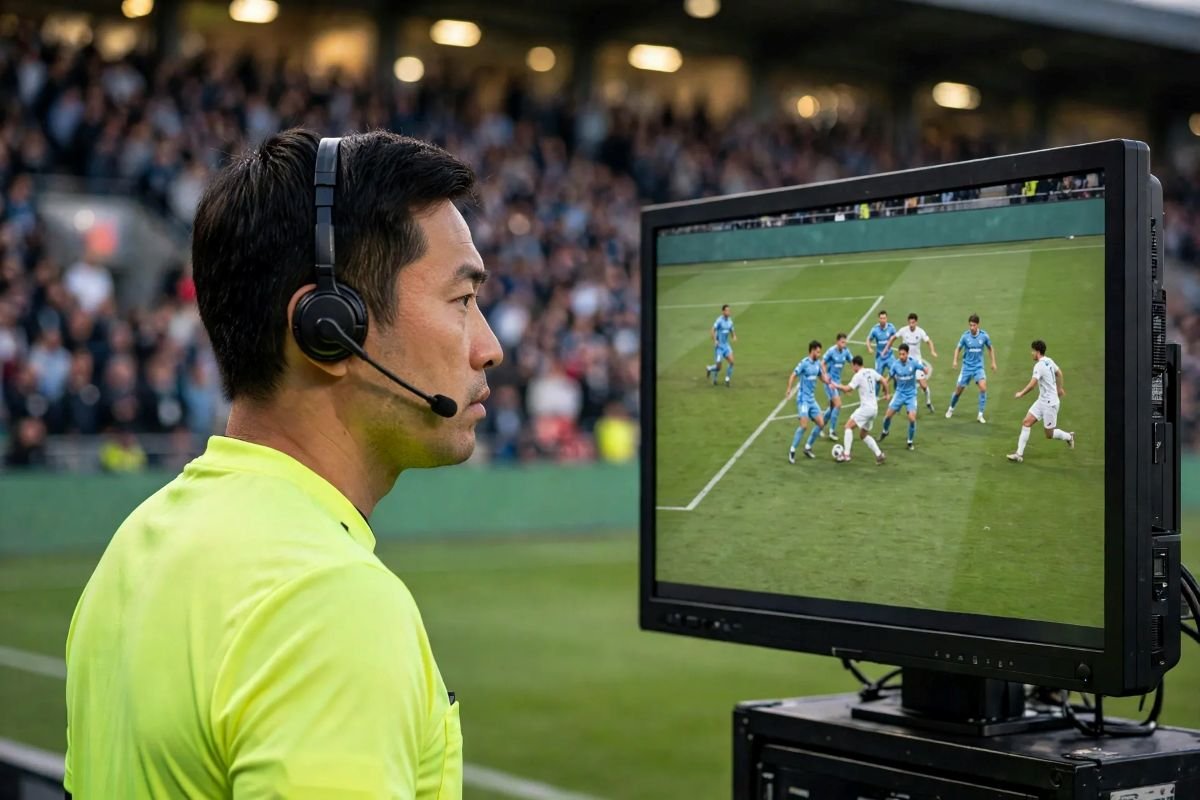
HAS VAR MADE FOOTBALL FAIRER OR TAKEN AWAY ITS MAGIC? THE TECHNOLOGY THAT CHANGED HOW MILLIONS EXPERIENCE THE BEAUTIFUL GAME
For generations, football supporters have experienced the same unforgettable emotions: the excitement of a last-minute goal, the frustration of a missed penalty, and the heartbreak of a referee’s decision that changes the outcome of an important match. Before video technology became part of the game, referees had to make almost every decision in real time. Sometimes they were right. Sometimes they were wrong. And when a mistake happened, there was often nothing anyone could do to change the result.
Then football entered a new era.
The Video Assistant Referee, better known as VAR, was introduced to major international competition at the 2018 FIFA World Cup in Russia. Its purpose was straightforward: help referees correct clear and obvious mistakes in important situations. For the first time, officials could review video footage, examine incidents from different angles, and reconsider decisions that might otherwise have gone unchallenged.
At first, the idea seemed like an obvious improvement. If technology could help prevent an unfair result, why should football refuse to use it?
However, several years after its introduction, the debate remains far from settled. VAR has helped correct important mistakes, but it has also created delays, confusion, and moments of disappointment. Supporters who once celebrated goals without hesitation now sometimes wait for confirmation before allowing themselves to enjoy the moment.
Has VAR made football better, or has the search for perfect decisions changed something special about the game?
WHAT VAR DOES WELL: PROTECTING THE GAME FROM MAJOR MISTAKES
The strongest argument in favor of VAR is its ability to help referees correct serious errors that could influence the outcome of a match.
The system is designed to assist officials in four main categories: goals and attacking incidents, penalty decisions, direct red cards, and mistaken identity.
Consider a situation in which an attacking player scores a goal after being in an offside position. At normal speed, the referee and assistant referee may find it difficult to judge the exact moment the ball was played. VAR can review the available footage and help determine whether the goal should stand.
The same principle applies to penalty decisions. A defender may clearly trip an opponent inside the penalty area, but the referee might not have a direct view of the incident. Video assistance can help identify whether a penalty should have been awarded.
VAR can also help when a serious foul or violent incident goes unnoticed. In certain circumstances, an official may review the footage and recommend that the referee reconsider the decision.
The technology became particularly visible during the 2018 FIFA World Cup in Russia, when it was used throughout the tournament. FIFA reported that VAR helped officials review important incidents and contributed to correcting decisions during the competition.
One of the most discussed consequences was the increase in penalty decisions compared with previous tournaments. However, this should not automatically be interpreted as evidence that every additional penalty was correct or that every earlier decision was wrong. It demonstrated how video review could bring previously overlooked incidents to the attention of officials.
For supporters, the principle is difficult to argue against. A team should not lose an important match because an obvious mistake went unnoticed when available technology could have helped the referee.
At its best, VAR protects the result by giving officials another opportunity to make the right decision.
THE OFFSIDE PROBLEM: WHEN A FOOTBALL MATCH IS DECIDED BY CENTIMETERS
Despite its advantages, VAR has created some of the most frustrating moments in modern football. One of the biggest sources of controversy is the interpretation of offside.
Under the Laws of the Game, an attacking player is generally in an offside position if part of the head, body, or feet that can legally score is nearer to the opponents’ goal line than both the ball and the second-last opponent when the ball is played, subject to the other requirements of the law.
The difficulty is that modern technology can identify extremely small differences in positioning.
A goal may be disallowed because an attacking player is judged to be marginally ahead of the defender. Sometimes the difference appears to be only a shoulder, a toe, or a small part of the body.
From a technical perspective, the decision may follow the offside rule. But from the perspective of supporters, it can feel difficult to accept that such a tiny difference should cancel a moment of extraordinary excitement.
This debate raises an important question: does greater measurement accuracy always produce a better football decision?
Offside is a rule, and officials must apply it consistently. Yet the way technology presents extremely marginal situations can influence how supporters understand fairness.
Semi-automated offside technology has helped make certain decisions faster and more consistent. Nevertheless, it does not remove every element of interpretation, particularly when officials must determine whether an attacking player is interfering with an opponent or becoming involved in active play.
The challenge is to use technology in a way that supports the purpose of the offside law rather than turning every attacking movement into a debate over microscopic measurements.
THE TIME PROBLEM: WHEN THE EXCITEMENT DISAPPEARS
Another major criticism of VAR concerns the time required to reach a decision.
Football is a sport built around rhythm. A match can change within seconds, and the emotional reaction of supporters is part of what makes the experience so powerful.
But when a goal is scored and officials begin a lengthy review, the atmosphere can change immediately.
Players wait near the halfway line. Supporters look toward the referee or the stadium screen. Television viewers watch repeated footage, sometimes without understanding exactly what the officials are checking.
In some cases, the review lasts only a short time. In others, it can take several minutes.
These interruptions can damage the natural flow of a match, particularly when the decision involves a complicated penalty or offside incident.
The problem is not simply that supporters dislike waiting. It is that the uncertainty changes the way people experience the most important moments of football.
Imagine watching your team score a decisive goal in the final minutes of a major match. Instead of immediately celebrating, you must wait for a video review. The goal may eventually be confirmed, but the initial excitement has already been interrupted.
For fans inside the stadium, the experience can be even more frustrating when they receive less information than television viewers.
Clearer explanations and faster reviews would help. VAR should not become a separate event that takes attention away from the football itself.
WHY FOOTBALL SUPPORTERS REMAIN DIVIDED
The disagreement surrounding VAR is not simply about technology. It reflects two different ideas about what football should protect.
Supporters who favor VAR often emphasize fairness and accuracy. They believe that important decisions should be based on the best available evidence. If a referee makes a clear mistake, technology should provide an opportunity to correct it.
For these supporters, a delayed celebration is a small price to pay if it prevents an unfair result.
Others place greater importance on the emotional experience of watching football. They remember a time when a goal meant immediate celebration, when a referee’s decision was accepted as part of the game, and when discussions about controversial incidents continued in pubs, homes, and stadiums after the final whistle.
They do not necessarily believe refereeing mistakes are good. Instead, they worry that excessive dependence on video reviews is changing the character of football.
Both perspectives deserve consideration.
Football needs fair decisions, but it also needs to preserve its natural rhythm. A system that improves accuracy while making every important moment feel uncertain risks creating a different kind of frustration.
The goal should not be to choose between fairness and emotion. It should be to find a way to protect both.
VAR STATISTICS: WHAT THE NUMBERS CAN AND CANNOT TELL US
VAR is now part of the refereeing structure in several major competitions. However, statistics from different leagues cannot always be compared directly because competitions may use different reporting methods, review classifications, and definitions of a changed decision.
The following table summarizes the main categories covered by the VAR protocol rather than presenting unverified league figures as official statistics.
| VAR review category | What officials can examine | Main purpose |
|---|---|---|
| Goals | Offside, attacking offences and other relevant incidents | Confirm or disallow a goal |
| Penalties | Clear missed or incorrectly awarded penalty incidents | Correct major penalty errors |
| Direct red cards | Possible serious foul play or violent conduct | Identify missed or incorrect dismissals |
| Mistaken identity | Whether the wrong player was penalized | Correct the identity of the player involved |
Source: International Football Association Board (IFAB), VAR Protocol and Laws of the Game.
It is important to distinguish between a decision being reviewed and a decision being changed. A review does not necessarily mean the referee made a mistake. Sometimes the footage confirms the original decision.
Similarly, the number of interventions alone cannot establish whether VAR has made a competition fairer. A meaningful evaluation must also consider whether the final decisions were correct, how consistently the rules were applied, and how much time the reviews required.
HOW VAR CAN BECOME BETTER WITHOUT DESTROYING THE GAME
The future of VAR should focus on improving the experience for everyone involved.
First, reviews should be completed as efficiently as possible. If an incident can be resolved through clear footage, there is little reason to allow the process to become unnecessarily complicated.
Second, communication must improve. Supporters inside stadiums deserve clear explanations of what is being reviewed and why a decision has been made. Referees and competition organizers should make important decisions easier to understand.
Third, officials must apply the intervention threshold consistently. VAR should not become an opportunity to review every minor contact or disagreement. Its purpose is to correct significant errors, not to replace the referee’s judgment in every situation.
Finally, technology should continue to develop in ways that make decisions faster and more transparent. Semi-automated systems can help with certain offside situations, while improved communication tools can help supporters follow the process.
The most successful version of VAR will be one that supporters barely notice. It will correct important mistakes when necessary, allow the match to continue whenever possible, and preserve the excitement that makes football special.
MY PERSPECTIVE
I believe VAR is necessary because an obvious refereeing mistake can unfairly change the result of an important match. However, I also understand why supporters feel frustrated when they cannot celebrate a goal without waiting for a review. For me, technology should protect fairness without taking away the spontaneous emotions that make football worth watching.
THE FINAL QUESTION: IS PERFECT FAIRNESS WORTH THE PRICE?
VAR has changed football forever. It has given referees access to information that previous generations could only have imagined, helped correct important mistakes, and forced the sport to reconsider how decisions should be made.
But it has also reminded us that football is not simply a mathematical exercise. It is a sport shaped by emotion, uncertainty, human judgment, and moments that can never be repeated in exactly the same way.
Technology can show whether a player was offside. It can help determine whether a foul occurred inside the penalty area. It can reveal an incident that the referee could not see.
Yet it cannot measure the excitement of a last-minute winner or fully explain the disappointment of a supporter whose celebration is suddenly interrupted.
The real challenge is not to make football depend on technology. It is to make technology serve football.
I still think VAR is useful, but I would love to see faster reviews and clearer explanations so fans can enjoy the game without constantly worrying about a decision being overturned. What about you: would you rather keep VAR with improvements, or return to the days when the referee’s decision was final?