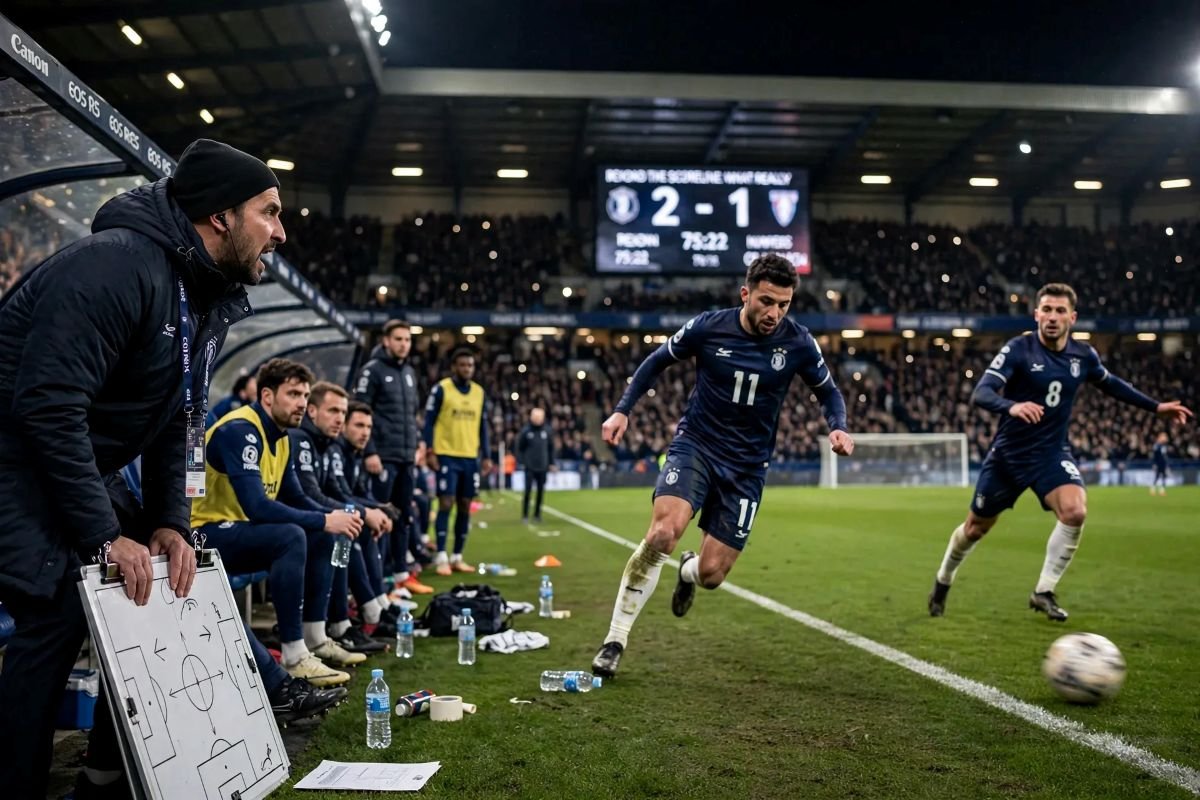
BEYOND THE SCORELINE: THE HIDDEN FACTORS THAT REALLY DECIDE A FOOTBALL MATCH
When we watch football, the first thing we usually look at is the final score. 2–1, 3–0, or 1–0. These numbers tell us which team won, which team lost, and how many goals were scored. But do they really tell us everything that happened during the match?
Not always.
A team can dominate possession, create more chances, and play better football, yet still lose because of one defensive mistake or a moment of brilliance from an opponent. Sometimes, the winning team is more efficient rather than more dominant. In other matches, a goalkeeper produces an extraordinary performance, a substitute changes the rhythm, or a single decision determines the outcome.
Football is much more complicated than the final score suggests. Mental strength, tactical decisions, individual quality, small details, and sometimes luck can all influence the result.
So, what really decides a football match beyond the scoreline?
Mentality Can Make the Difference in Big Games
In major competitions, the difference between two teams is not always their technical ability. Both sides may have world-class players, experienced managers, and carefully prepared tactical plans. When the quality of the teams is similar, mental strength can become a decisive advantage.
Real Madrid’s performances in the UEFA Champions League provide some memorable examples. The Spanish club has developed a reputation for remaining dangerous even when the situation appears almost impossible. Their comeback against Manchester City in the 2021–2022 semi-final is a remarkable illustration.
In the second leg at the Santiago Bernabéu, Real Madrid were trailing 1–0 on the night and 5–3 on aggregate as the match approached its final moments. Rodrygo scored twice in stoppage time, taking the game into extra time. Karim Benzema then scored from the penalty spot, completing an extraordinary turnaround and sending Real Madrid into the final.
What made this comeback so remarkable was not simply the goals. It was the team’s ability to continue believing, remain focused, and take advantage of the opportunities that appeared.
Mentality does not mean that a team can win through confidence alone. Players still need technical quality, tactical discipline, and physical preparation. However, staying calm under pressure can help a team make better decisions when the match becomes difficult.
The opposite is also true. A team that loses confidence after conceding a goal may begin making unnecessary mistakes. Players can become impatient, defensive organization can disappear, and simple passes suddenly become difficult.
In high-pressure matches, the ability to control emotions can be just as important as controlling the ball.
Small Details Can Change an Entire Match
Football matches are often decided by moments that last only a few seconds. A poorly defended corner, an unnecessary foul, a misplaced pass, or a goalkeeper’s mistake can change the direction of a game.
One of the clearest examples came during the 2022 FIFA World Cup final between Argentina and France.
Argentina appeared to be in control after Lionel Messi scored a penalty in the 23rd minute and Ángel Di María added a second goal in the 36th minute. France struggled to create clear opportunities for much of the first half and appeared to be heading toward defeat.
However, the match changed dramatically late in the second half. Kylian Mbappé scored a penalty in the 80th minute, then equalized with a spectacular volley in the 81st minute. In approximately two minutes, France had transformed a 2–0 deficit into a 2–2 draw.
The first goal came from a penalty after a foul in the penalty area, while the second resulted from a quick attacking combination finished brilliantly by Mbappé. These were two different moments, but together they changed the entire atmosphere of the final.
The match eventually finished 3–3 after extra time, with Argentina winning 4–2 in the penalty shootout.
This final demonstrated how quickly football can change. Argentina had controlled much of the match, but France needed only a short period of attacking brilliance to bring themselves back into the contest.
Set pieces are another important example of how small details influence results. Corners and free kicks can create scoring opportunities even against teams that defend very well in open play. A well-delivered cross, an intelligent run, or a perfectly timed header can decide a match in which neither side has created many chances.
That is why professional teams spend so much time practicing these situations. A single set-piece opportunity can be worth as much as a long period of attacking pressure.
The Bench and the Coach Can Decide the Final Minutes
Modern football is not simply a contest between the 11 players who start the match. Substitutes, tactical adjustments, and decisions made by the manager can have a major influence on the outcome.
A team may begin with a strong starting lineup, but the physical demands of football can change the game as the minutes pass. Wingers lose speed, midfielders become tired, and defenders may struggle to maintain their concentration.
This is where the coach’s decisions become important.
A manager can introduce a fast winger to attack a tired full-back, bring on a creative midfielder to improve possession, or replace an exhausted defender to protect a narrow lead. These changes can create new attacking opportunities or help a team maintain its defensive structure.
However, substitutions are not automatically successful. A player needs time to understand the rhythm of the match, and an attacking change can sometimes leave a team more exposed defensively.
A good coach must understand not only which player to introduce, but also when and why that player should enter the game.
The 2022 World Cup final offered a memorable example of the importance of squad depth and tactical decisions. France introduced several substitutes during the match, including Randal Kolo Muani and Kingsley Coman. Kolo Muani played an important role in the late attacking revival, while Coman came on during extra time and later took part in the penalty shootout.
Argentina also used substitutions to manage the physical demands of the match and adjust their attacking options. Ultimately, both managers had to make decisions in a game that continued for 120 minutes.
The strongest teams do not necessarily win because they have the most famous substitutes. They benefit from having players who can perform different roles and give the manager more tactical options.
Statistics Do Not Always Explain the Full Story
Football statistics are useful, but they must be interpreted carefully. Possession, shots, passing accuracy, and expected goals can help explain how a match developed. However, none of these numbers alone can guarantee victory.
A team might have 65% possession but struggle to create clear chances. Another team might have only 35% possession but score twice through quick counterattacks.
The same applies to shots. A team can attempt 20 shots from difficult positions and still lose to an opponent that creates only three clear opportunities.
The important question is not simply how much a team has of the ball, but what it does with that possession.
Expected goals, commonly known as xG, can also provide useful information. This statistic estimates the likelihood that a particular shot will result in a goal based on factors such as the shooting position and type of chance. It helps explain the quality of opportunities, although it cannot predict exactly what will happen in an individual match.
The following table summarizes several important factors without assigning unsupported percentages to their influence.
STATISTICS TABLE: WHAT REALLY INFLUENCES A FOOTBALL MATCH?
| Factor | What It Can Influence | Example |
|---|---|---|
|
Mentality |
Decision-making under pressure | Real Madrid’s comeback against Manchester City in 2022 |
|
Possession |
Control of the game’s rhythm | Barcelona under Pep Guardiola |
|
Set Pieces |
Scoring opportunities from dead-ball situations | Corners and free kicks |
| Substitutions | Fresh energy and tactical changes |
France’s substitutions in the 2022 World Cup final |
|
Individual Quality |
Match-changing moments | Mbappé’s two late goals in the 2022 final |
| Defensive Errors | Opportunities for the opposition |
Penalties, misplaced passes, and poor marking |
| Luck and Fine Margins | Unpredictable events and narrow outcomes |
Shots hitting the post or penalty shootouts |
Source: Examples and football concepts summarized from FIFA World Cup records, UEFA competition reports, and historical match records.
These factors do not operate separately. A team’s mentality can influence its decision-making, while a coach’s substitutions can change the tactical structure. A set piece may become decisive because of excellent delivery, poor defending, or both.
The final score is the result of many connected events, not one isolated statistic.
Why We Should Look Beyond the Final Score
Understanding football means learning to watch more than the scoreboard. It means noticing how a team moves without the ball, how midfielders create space, how defenders communicate, and how players respond after conceding a goal.
A team that loses 1–0 may have played an excellent match but failed to convert its chances. A team that wins 1–0 may have defended brilliantly and taken advantage of one decisive opportunity. Both performances deserve to be understood in their proper context.
This does not mean that the result is unimportant. Football is a competitive sport, and winning remains the ultimate objective. But the quality of a performance cannot always be measured by the number of goals scored.
The best way to understand a match is to consider both the result and the events that produced it. Statistics provide evidence, tactics explain decisions, and individual moments reveal the human side of the game.
My Perspective
I used to think football was only about which team scored more goals. Now, I watch the substitutes, the coach’s reactions, and the way players respond after conceding a goal. When my team loses but fights until the final whistle, I can still feel proud of their performance, just as a victory without commitment or determination does not always make me happy.
For me, the scoreline tells us who won, but the story behind it tells us what football really means.
What do you think? Is mentality the most important factor in deciding a football match, or do tactics, individual quality, and small details matter even more?