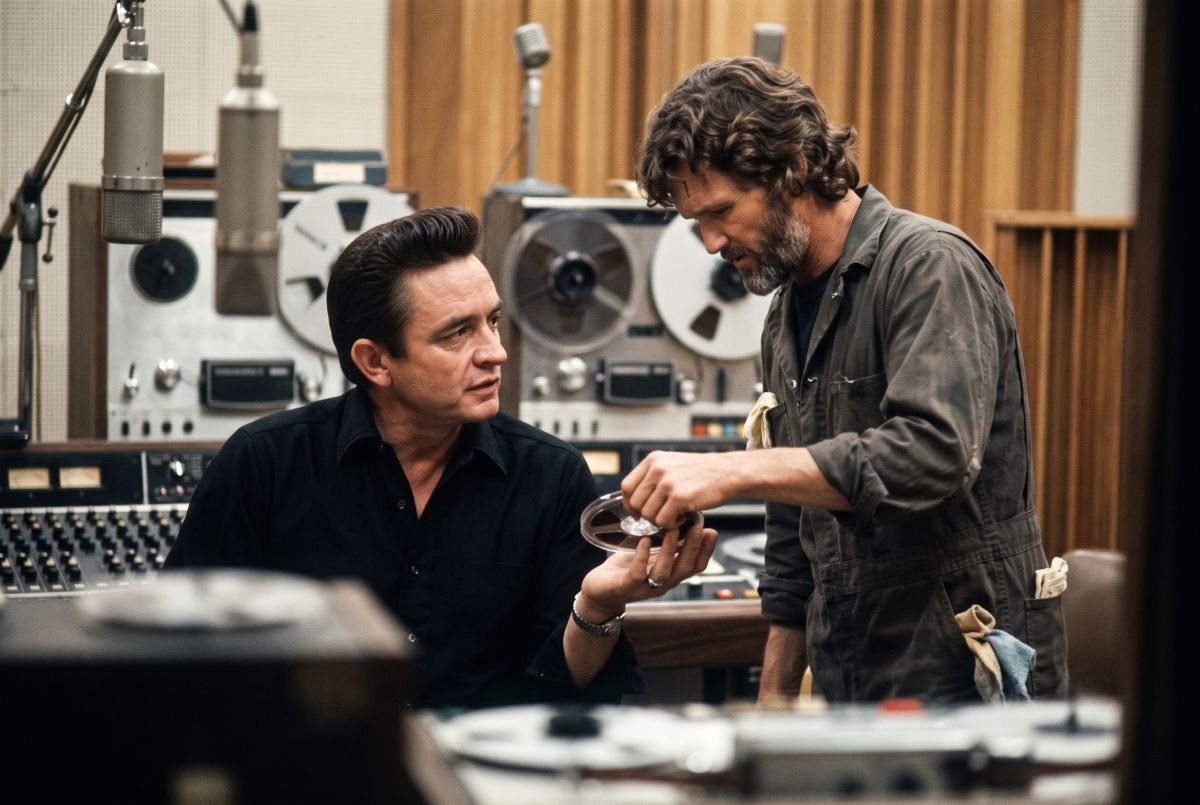
THE UNEXPECTED MOMENT THAT CHANGED EVERYTHING: JOHNNY CASH HEARS KRIS KRISTOFFERSON’S SONG AND OPENS THE DOOR TO A NEW LIFE
Sometimes, a life can change because of one song.
For Kris Kristofferson, that turning point came during a period when almost nobody in the music industry knew his name. He had written songs for years, dreamed of becoming a professional songwriter, and continued pursuing music despite having a demanding career outside the entertainment world.
He was not yet the celebrated singer, songwriter, and actor audiences would eventually recognize.
He was simply a man trying to find a way into Nashville.
And then Johnny Cash heard one of his songs.
The meeting between Cash and Kristofferson has become one of the most memorable stories in country music history. Although some popular retellings have exaggerated the details, the broader story is well documented: Cash recognized Kristofferson’s songwriting talent and helped bring attention to his work at a crucial moment.
Kristofferson’s path to Nashville had been anything but ordinary.
Born in Brownsville, Texas, in 1936, he was an exceptionally accomplished young man. He attended Pomona College, earned a Rhodes Scholarship, and studied at Oxford University. He later served in the United States Army, where he became a helicopter pilot.
By conventional standards, Kristofferson had a promising professional future ahead of him.
But music continued to pull him in another direction.
After leaving military service, he moved toward Nashville and began pursuing songwriting. He took various jobs while trying to establish himself, refusing to abandon the dream that had brought him to Music City.
One of those jobs became central to the legend surrounding his early career.
Kristofferson worked at Columbia Recording Studios in Nashville, where he performed maintenance duties. Popular stories have often described him as a janitor, sweeping floors while hoping someone would eventually listen to his songs.
The image is almost cinematic: a highly educated former military officer cleaning a recording studio while carrying songs in his head that he believed deserved to be heard.
But the reality was more complicated.
Kristofferson was not simply waiting for destiny to find him. He was actively pursuing songwriting, meeting musicians, writing constantly, and looking for opportunities.
Among the songs he wrote was “Sunday Mornin’ Comin’ Down.”
The song captured loneliness, regret, and the emptiness of a Sunday morning after a difficult night. It was not a conventional country song built around simple optimism. Instead, it told the story of a troubled person confronting the emotional consequences of his choices.
The writing immediately demonstrated Kristofferson’s unusual ability to tell stories.
Eventually, the song came to the attention of Johnny Cash.
Cash recognized something in Kristofferson’s writing.
That recognition mattered enormously.
Cash was already one of the biggest names in country music. His approval could bring attention to a songwriter who otherwise might remain unknown. He eventually performed “Sunday Mornin’ Comin’ Down” and recorded it, helping turn Kristofferson’s songwriting into something the wider country audience could discover.
Cash’s support did not instantly transform Kristofferson into a superstar overnight, but it helped create an important opening.
Then came another remarkable moment.
At the 1970 Newport Folk Festival, Cash introduced Kristofferson to a much larger audience. Cash’s endorsement gave the young songwriter credibility at a moment when he was still trying to establish himself.
Kristofferson’s career soon accelerated.
Artists began recording his songs, and his reputation as a songwriter grew rapidly. “Me and Bobby McGee,” “Help Me Make It Through the Night,” “For the Good Times,” and other compositions demonstrated that he could write about complicated human experiences with remarkable honesty.
His songs were recorded by some of the biggest performers in country and popular music.
What had once seemed like an unlikely dream was becoming reality.
Yet the most fascinating part of Kristofferson’s story is that Johnny Cash did not create his talent.
He recognized it.
Kristofferson had already spent years developing his craft. He had written through rejection and uncertainty. He had made sacrifices to pursue music. Cash’s support mattered because it arrived when an opportunity could make a difference.
That distinction makes the story even more meaningful.
Success rarely comes from one moment alone.
Behind every breakthrough is usually a long period of preparation that the public never sees.
For Kristofferson, those unseen years included education, military service, difficult career decisions, songwriting, financial uncertainty, and countless attempts to get his work noticed.
Then, finally, someone with influence listened.
Johnny Cash became one of the people who helped open that door.
The two eventually became close friends and collaborators. Their relationship grew into one of the most celebrated friendships in country music.
In 1985, they joined Willie Nelson and Waylon Jennings to form The Highwaymen, creating one of country music’s most famous supergroups.
By then, Kristofferson was no longer the unknown songwriter trying to get someone to hear his work. He had become an accomplished recording artist in his own right, a respected songwriter, an actor, and a major figure in American music.
But the memory of those early days remained important.
His story is a reminder that talent can exist long before recognition arrives.
Sometimes the world simply needs someone to notice.
Johnny Cash happened to be one of the people who noticed Kris Kristofferson.
And that seemingly simple act—hearing a song and believing in the person who wrote it—helped change the direction of a remarkable career.
There is something deeply inspiring about the contrast.
One man was already a legend.
The other was still trying to prove that his songs mattered.
Cash had the platform.
Kristofferson had the words.
When those two things came together, a door opened.
But Kristofferson still had to walk through it.
He continued writing. He continued performing. He continued creating music that would eventually become part of the American cultural landscape.
That is why the story should not be remembered merely as a fairy tale in which Johnny Cash magically discovered an unknown janitor.
The truth is more powerful.
Kris Kristofferson had already spent years preparing for his opportunity. Johnny Cash helped make that opportunity visible.
One songwriter heard another songwriter’s voice.
One established artist gave an emerging talent a chance.
And from that connection came a friendship, a career, and some of the most enduring songs in country music history.
Sometimes destiny does not arrive with a dramatic announcement.
Sometimes it arrives quietly—in the form of one person listening to a song at exactly the right moment.