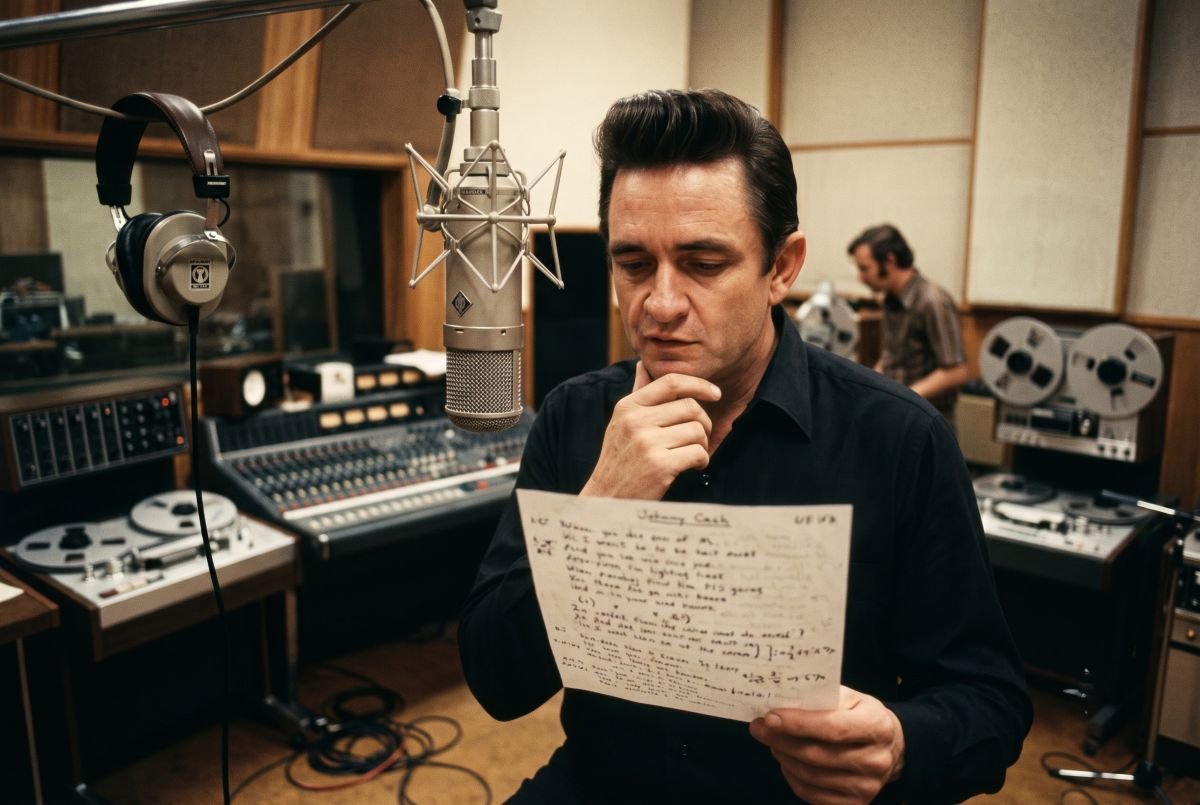
THE UNTOLD STORY: JOHNNY CASH, HIS FAMOUS BLACK CLOTHES, AND THE POWERFUL MEANING BEHIND “MAN IN BLACK”
Few figures in American music were as instantly recognizable as Johnny Cash. With his deep voice, commanding presence, and unmistakable appearance, Cash created an image that remained connected to him throughout his extraordinary career. But among all the things people remember about him, perhaps nothing became more symbolic than his habit of wearing black clothing.
For years, audiences saw Cash step onto stages dressed almost entirely in black. The look eventually earned him one of the most famous nicknames in music history: “The Man in Black.” To some observers, the clothing was simply part of his distinctive style. But Cash himself gave the color a much deeper meaning.
In 1971, he explained that idea through one of his most memorable songs, “Man in Black.” The song offered a direct explanation for why he chose to dress the way he did, and the answer had little to do with fashion.
Cash described black as a symbol of solidarity with people who were struggling, forgotten, or treated unfairly. His lyrics referred to poverty, prisoners, war, and people living on the margins of society. Rather than presenting himself as someone above those people, Cash used his public image to draw attention to their experiences.
The message was remarkably simple: he wore black because there were many things in the world that he believed deserved to be remembered.
This idea was consistent with much of Cash’s career.
From the beginning, his music frequently focused on people who lived outside the comfortable center of society. He sang about prisoners, workers, soldiers, farmers, families, and people facing difficult circumstances. His songs often gave a voice to characters who might otherwise have remained invisible.
One of the clearest examples was his famous connection with prison audiences.
Cash performed at Folsom Prison in 1968, an event that became one of the defining moments of his career. The resulting live album, At Folsom Prison, became a major success and helped strengthen his reputation as an artist who was willing to perform for people whom others might overlook.
His appearance at prisons was not merely a stage gimmick. Cash had long been interested in the lives of incarcerated people and had spoken about the importance of rehabilitation and humane treatment. His music allowed him to connect with audiences who often felt separated from mainstream society.
The black clothing became a visual extension of that philosophy.
Cash also connected the color with war and national suffering. The United States had experienced enormous social and political tensions during the 1960s and early 1970s, and the Vietnam War had deeply divided the country. Cash’s “Man in Black” addressed the pain created by conflict and the people affected by it.
Yet there was another important aspect to his explanation: black was also a practical color.
Cash reportedly liked the simplicity of wearing dark clothes because they were easy to coordinate and worked well on stage. His early performances with The Tennessee Two helped establish the look, and over time it became inseparable from his identity.
What began partly as a practical choice eventually became something much larger.
By the time audiences heard “Man in Black,” Johnny Cash’s appearance had already become legendary. The song transformed that recognizable image into a clear statement of purpose.
Cash was not claiming that every person wearing black shared his beliefs. Instead, he was explaining why he personally chose the color and what he wanted it to represent.
That distinction makes the song particularly interesting.
Cash’s music often avoided complicated language. He preferred direct storytelling and plainspoken observations. In “Man in Black,” he used that same approach to explain an image that millions of people had already noticed.
The result was both a personal statement and a social reflection.
The song also revealed something important about Cash himself. Beneath the famous stage persona was an artist deeply interested in human stories. He understood that music could entertain people, but he also believed it could draw attention to those who were suffering.
That philosophy helped explain why his career crossed so many boundaries. Cash performed country music, but his audience extended far beyond country fans. He recorded gospel, folk, rock, and traditional American songs. He worked with musicians from different backgrounds and continued reinventing himself throughout his career.
His black clothing remained a constant.
Even as musical styles changed, technology evolved, and generations of performers came and went, Johnny Cash continued to appear in that familiar dark attire. It became more than clothing. It became a symbol of identity, compassion, independence, and remembrance.
There is a particularly powerful irony in the story. The color black is often associated with darkness or sadness, yet Cash used it to communicate something more hopeful: people who are struggling should not be forgotten.
That message helped make “Man in Black” one of the most revealing songs of his career.
Johnny Cash died in 2003, but the image of the Man in Black remains deeply embedded in popular culture. His recordings continue to reach new listeners, and his influence can still be heard in generations of musicians who followed him.
His black clothes remain perhaps the simplest visual reminder of who he was.
But the real story was never just about what Johnny Cash wore.
It was about why he wore it.
Behind the dark suits was an artist who wanted his music to acknowledge people living through hardship, people behind prison walls, people affected by war, and people whose struggles were easy for society to overlook.
That is what gave the Man in Black his enduring meaning.
Johnny Cash did not simply create a memorable appearance. He turned that appearance into a message—and turned a color into a part of his legacy.
VIDEO