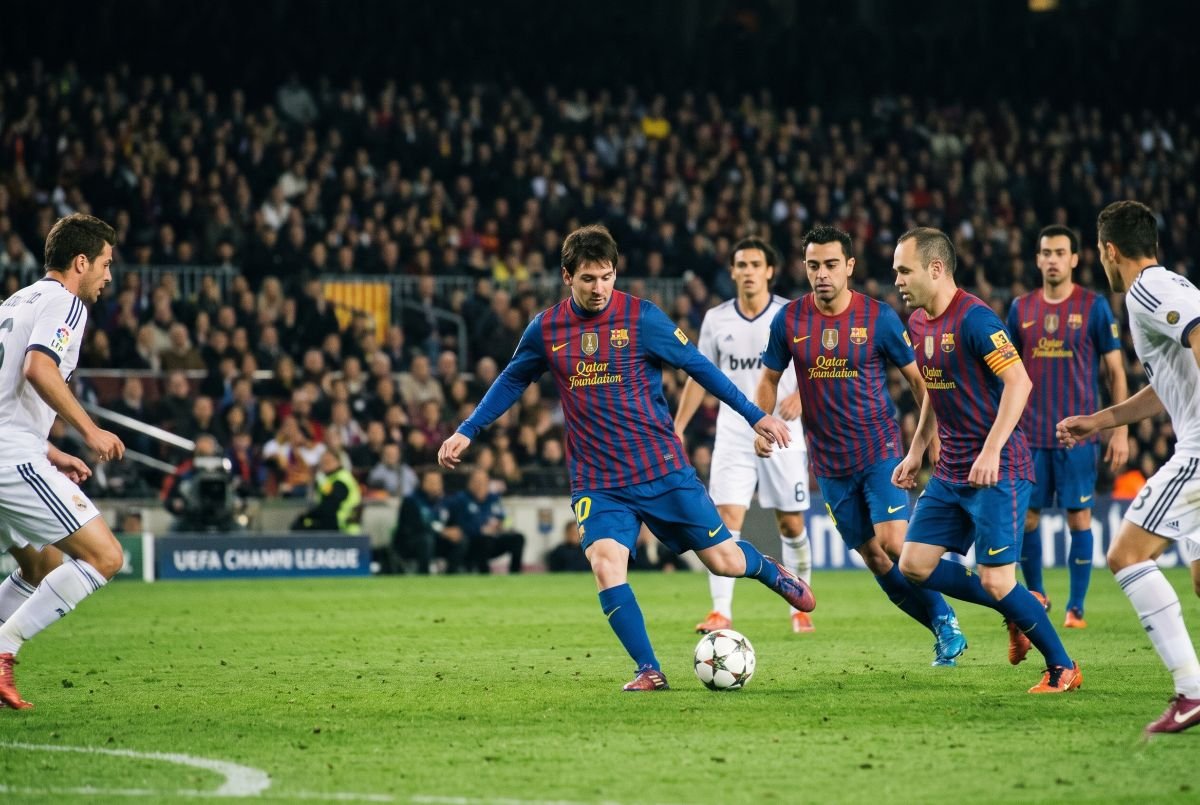
BARCELONA’S TIKI-TAKA REVOLUTION: HOW PEP GUARDIOLA TURNED FOOTBALL INTO AN ART FORM
In the early 2010s, FC Barcelona became one of the most influential football teams in modern history. Under Pep Guardiola, the club developed a distinctive style of play built around short passing, intelligent movement, technical excellence, and extraordinary control of possession. Their performances captivated millions of supporters and changed the way many people understood the game.
At the heart of this football revolution was Tiki-Taka. Barcelona did not simply want to score goals; they wanted to control the rhythm of every match, dictate the movement of their opponents, and create opportunities through patient passing. With players such as Xavi Hernández, Andrés Iniesta, Sergio Busquets, and Lionel Messi, they transformed possession-based football into one of the most recognizable playing styles in the world.
What Is Tiki-Taka?
Tiki-Taka is a football philosophy commonly associated with short, quick passes, constant movement, and maintaining possession. Players frequently use one or two touches, moving the ball between teammates while searching for open spaces. Instead of relying entirely on physical strength or long passes, the system emphasizes technique, awareness, positioning, and teamwork.
However, Tiki-Taka is much more complicated than simply passing the ball repeatedly. Every player must understand where teammates are positioned, recognize spaces before they become available, and move at the right moment. A successful passing combination requires intelligence and coordination from the entire team.
Barcelona’s approach also included immediate pressing after losing possession. Rather than retreating and allowing opponents to organize their attacks, players attempted to recover the ball as quickly as possible. This reduced the opposition’s time and space and helped Barcelona regain control of the match.
The philosophy was built around an important principle: a team that controls possession can limit the opponent’s opportunities to attack. Nevertheless, possession alone does not guarantee victory. Barcelona’s success came from combining ball control with creativity, pressing, movement, and the ability to turn possession into dangerous attacking opportunities.
Why Barcelona’s 2011–2012 Team Was So Special
The 2011–2012 season remains one of the most memorable periods in Barcelona’s history. Although the club did not win La Liga or the Champions League that season, its attacking performances demonstrated the extraordinary quality of Guardiola’s squad.
Each player had a specific responsibility within the system.
Xavi Hernández was the team’s midfield controller. His vision, passing accuracy, and understanding of space allowed Barcelona to dictate the tempo of matches. He could identify passing opportunities and maintain possession even under intense pressure.
Andrés Iniesta brought creativity and elegance. His close control, dribbling ability, and movement helped Barcelona escape crowded midfield areas. When the team needed to break through a defensive line, Iniesta often provided the solution.
Sergio Busquets was the foundation of the midfield. His positioning and awareness allowed him to intercept passes, protect the defense, and connect the defensive and attacking phases. His importance was not always reflected in goals or assists, but his contribution was essential to the team’s balance.
Then there was Lionel Messi, the player who transformed Barcelona’s possession into goals. His dribbling, finishing, movement, and creativity made him one of the most dangerous attacking players in football history.
During the 2011–2012 season, Messi scored an extraordinary 73 goals in all competitions, setting a remarkable individual benchmark for a European club season. Barcelona also scored approximately 190 goals across all competitions, demonstrating the attacking power of Guardiola’s team.
Some of their most memorable performances came against major European rivals. In December 2011, Barcelona defeated Real Madrid 3–1 at the Santiago Bernabéu in La Liga. They also beat AC Milan 3–1 at Camp Nou in the second leg of their Champions League quarter-final, securing their place in the semi-finals.
However, the season did not end with the European trophy many supporters had hoped for. Chelsea eliminated Barcelona in the Champions League semi-finals, winning 3–2 on aggregate. Barcelona also finished second in La Liga, behind Real Madrid, but ended the campaign by winning the Copa del Rey.
These results are important because they show that even one of the greatest teams of its era could experience disappointment. Barcelona’s 2011–2012 campaign was extraordinary in terms of attacking football, but it was not a season in which the club won every major competition.
The Players Who Made Tiki-Taka Work
Tiki-Taka was never the achievement of one individual. It depended on players who understood their responsibilities, trusted one another, and followed the same football philosophy.
| Player | Main Role | Key Contribution |
|---|---|---|
|
Xavi Hernández |
Midfield controller | Passing, tempo, and distribution |
|
Andrés Iniesta |
Creative midfielder | Dribbling and breaking defensive lines |
|
Sergio Busquets |
Defensive midfielder | Positioning and ball recovery |
|
Lionel Messi |
Forward | Goals, creativity, and attacking movement |
| Dani Alves | Attacking full-back |
Width and overlapping runs |
| Gerard Piqué | Central defender |
Defensive organization and building attacks |
Source: Historical player roles and team structure summarized from FC Barcelona’s 2011–2012 season records.
The relationship between these players was particularly important. Xavi and Iniesta controlled the midfield, Busquets provided defensive balance, and Messi offered a constant attacking threat. Dani Alves created additional width on the right, while Piqué helped Barcelona build attacks from the defensive line.
Their understanding developed through years of playing together, training, and following a shared football philosophy. This connection made the system difficult to reproduce simply by signing technically gifted players. Tiki-Taka required players who understood not only how to pass, but also when to move, where to position themselves, and how to support one another.
Why Tiki-Taka Became More Difficult to Use
As Barcelona achieved success, opponents began studying their style more carefully. Teams realized that trying to compete with Barcelona in possession was often a difficult strategy. Instead, some opponents focused on defending compactly, closing central spaces, pressing at carefully chosen moments, and attacking quickly after recovering the ball.
Chelsea’s Champions League victory over Barcelona in 2012 became a memorable example of this approach. Chelsea defended with discipline, limited Barcelona’s space near goal, and used counterattacks to exploit opportunities. Despite Barcelona’s attacking pressure, Chelsea advanced to the final after winning 3–2 on aggregate.
Other teams also developed effective ways to challenge possession-based football. High pressing could disrupt Barcelona’s passing rhythm, while fast transitions could exploit the spaces left behind by attacking full-backs and advanced midfielders.
Bayern Munich also demonstrated the effectiveness of intense pressing and direct attacking football against Barcelona in the 2013 Champions League semi-finals. Bayern won 7–0 on aggregate, although this happened after Guardiola’s departure from Barcelona and should be understood as part of the wider evolution of tactics rather than evidence that Tiki-Taka had suddenly become useless.
The truth is that Tiki-Taka did not simply fail. Football evolved, opponents adapted, and possession-based teams had to find new ways to create space and attack. No tactical system remains unbeatable forever.
How Tiki-Taka Changed Modern Football
Barcelona’s influence extended far beyond the trophies they won. Their success helped popularize a style in which goalkeepers, defenders, and midfielders were expected to participate in building attacks. Passing under pressure, controlling space, and maintaining possession became increasingly important qualities in elite football.
The influence of Guardiola’s Barcelona can still be seen in many modern teams. Coaches around the world have studied their positioning, pressing, and movement. Many leading clubs now attempt to build attacks from the back, use short passing combinations, and control the midfield through intelligent positioning.
However, modern possession football is not necessarily identical to Barcelona’s original approach. Today’s teams often combine patient passing with direct runs, quick transitions, and flexible attacking patterns. The principles remain influential, but the game continues to evolve.
Barcelona’s greatest contribution was demonstrating how technical ability, tactical intelligence, and collective movement could become a powerful competitive advantage. Their football reminded supporters that controlling a match could be just as impressive as scoring a spectacular goal.
My Perspective
When I watched Barcelona in 2012, I felt as though I was watching art rather than football. The ball moved so smoothly between players that I sometimes counted more than 20 passes without the opposition touching it. I even tried to play Tiki-Taka with my friends in my small town, but we often lost possession after just three passes, and that experience helped me understand how difficult the system really was.
For me, Guardiola’s Barcelona remains one of the most beautiful teams I have ever watched, not simply because of their results, but because of the intelligence, teamwork, and creativity behind every movement.
What do you think? Was Guardiola’s Barcelona the most beautiful football team of the modern era, or have other teams since then created an even more impressive style of play?