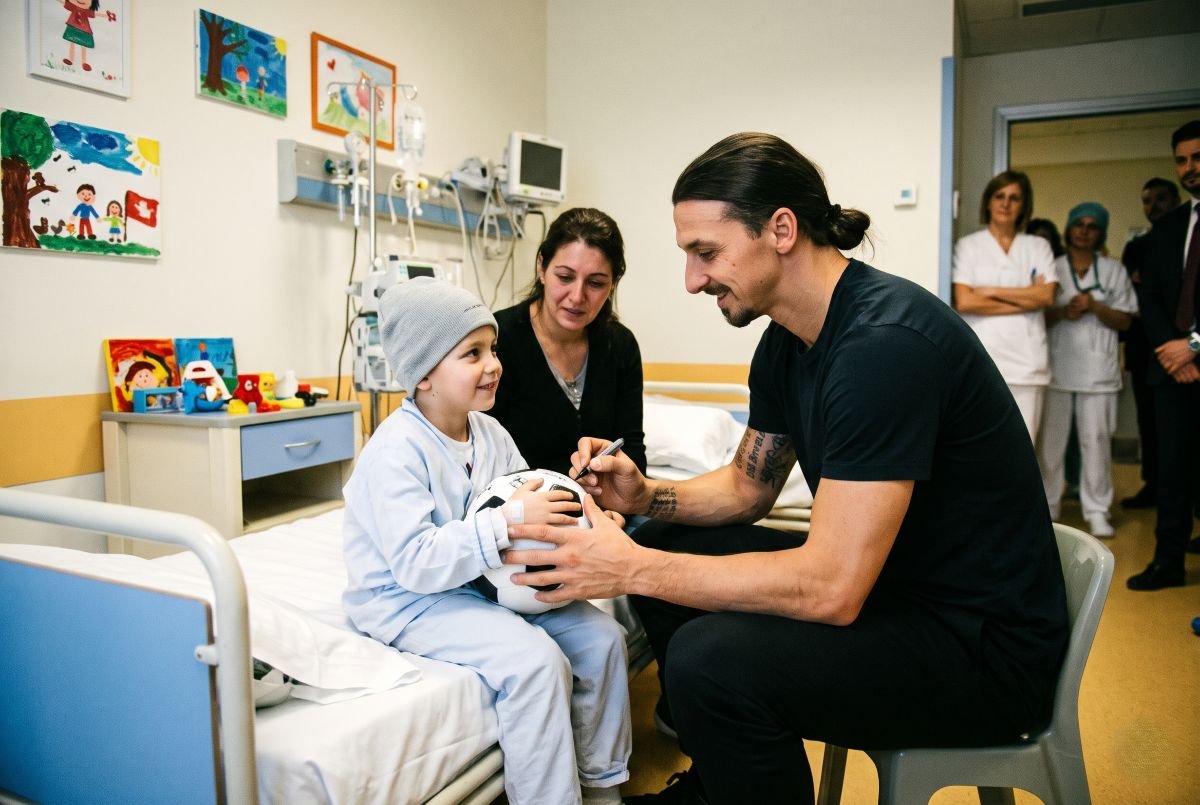
BEHIND ZLATAN IBRAHIMOVIC’S ARROGANT IMAGE: THE HUMBLE BEGINNINGS AND CHARITABLE ACTIONS MANY FOOTBALL FANS OVERLOOK
When people hear the name Zlatan Ibrahimović, they often think of confidence, bold statements, and a personality that refuses to be ignored. Throughout his career, Zlatan has made headlines with comments such as “I am Zlatan” and his famous comparison of himself to a lion. He has never been afraid to speak about his own abilities, and his personality has divided football supporters for years.
But there is another side to the former Swedish international that deserves attention.
Behind the confident public image is a man who grew up in a working-class neighbourhood, experienced financial difficulties, and understood what it meant to have limited opportunities. His background has helped shape his perspective on life, and over the years, he has used his fame to support charitable causes.
His story reminds us that a person’s public personality does not always reveal everything about their character.
Growing Up in Rosengård: A Childhood Far From Luxury
Zlatan was born on October 3, 1981, in Malmö, Sweden. His father, Šefik Ibrahimović, was born in Bosnia, while his mother, Jurka Gravić, came from Croatia. His parents separated when he was young, and he spent much of his childhood in Rosengård, a neighbourhood known for its large immigrant community.
Life was not always easy. His family faced financial difficulties, and Zlatan has spoken openly about growing up in an environment where money was limited. Football became an important part of his childhood, offering him an escape from everyday problems and a chance to imagine a different future.
He developed his skills playing football in the streets and local neighbourhoods. His early experiences were not like those of young players who grow up with expensive academies, private coaching, and every modern training facility available.
Zlatan’s personality was shaped partly by this environment. He learned to stand up for himself, compete with others, and believe in his own abilities, even when people doubted him.
His journey from Rosengård to some of Europe’s biggest football clubs was remarkable. He played for Ajax, Juventus, Inter Milan, Barcelona, AC Milan, Paris Saint-Germain, and Manchester United, among others.
However, his connection to Malmö remained important. He never completely separated his identity from the neighbourhood where his football journey began.
Zlatan Court: Giving Something Back to the Place Where It All Began
One of the most recognizable projects connected to Zlatan’s relationship with his hometown is Zlatan Court, a football facility in Rosengård.
The pitch was opened in 2007 through a collaboration involving Zlatan and sportswear company Nike. It was created as a place where local children and young people could play football in the neighbourhood.
The project carried symbolic importance. Zlatan had grown up playing football in Malmö, and the new facility represented an opportunity for younger generations to enjoy the same sport that had changed his life.
It is important to distinguish this project from claims that Zlatan personally financed and built numerous football fields for disadvantaged children. The documented story is more specific: Zlatan Court was a community football project connected to his hometown and supported through a partnership with Nike.
Nevertheless, its message was meaningful. A successful athlete can use his reputation to bring attention, resources, and opportunities to the community that helped shape him.
For children growing up in Rosengård, seeing someone from their neighbourhood reach the highest levels of international football could also provide something difficult to measure: inspiration.
Fighting Hunger: Zlatan’s World Food Programme Campaign
In 2015, Zlatan became involved in a memorable campaign with the World Food Programme (WFP), the United Nations agency working to combat hunger around the world.
The campaign was called 805 Million Names, referring to the number of people who were estimated to be suffering from chronic hunger at that time.
During a Paris Saint-Germain match, Zlatan revealed temporary tattoos bearing the names of people affected by hunger. The striking appearance attracted international attention and created a powerful visual message.
His intention was to make people think about those who were struggling to obtain enough food. Rather than using the occasion to promote his football achievements, he used his public visibility to direct attention toward a global humanitarian problem.
The campaign became one of the most memorable charitable initiatives associated with his career.
There is an important distinction here: the campaign was primarily an awareness initiative. It would be misleading to claim that Zlatan personally donated more than one million euros to the World Food Programme without reliable documentation.
Still, raising awareness can be valuable. Hunger is a problem that often receives less attention than major sporting events or celebrity news. By using his popularity to bring the issue into public discussion, Zlatan helped the organization reach a much wider audience.
During COVID-19, He Used His Influence to Support Italian Hospitals
Another important moment came in 2020, when the COVID-19 pandemic placed enormous pressure on hospitals and healthcare workers across Italy.
At the time, Zlatan was playing for AC Milan and had a strong connection to the country. He responded by launching a fundraising initiative to support hospitals, including Humanitas, a healthcare group in the Milan area.
He encouraged people to contribute and used his large social media following to spread the message.
His public appeal emphasized that the pandemic was bigger than football and that everyone who was able to help should consider doing so.
This initiative demonstrated another side of his influence. Although Zlatan was famous for his confidence and competitive personality, he recognized that a public figure could use that attention to encourage people to support others during a crisis.
The pandemic also reminded the football world that players are part of wider communities. Their responsibilities do not necessarily end when they leave the stadium.
Zlatan’s Charity Work: Important Milestones
The following table summarizes several documented activities and projects associated with Zlatan’s charitable involvement.
| Activity | Location or Organization | Year |
|---|---|---|
|
Zlatan Court community football project |
Rosengård, Malmö, with Nike |
2007 |
| 805 Million Names hunger-awareness campaign |
World Food Programme |
2015 |
|
COVID-19 hospital fundraising initiative |
Italy, including Humanitas |
2020 |
|
Support for his hometown community |
Malmö, Sweden |
Various years |
Source: Historical information compiled from World Food Programme campaign records, contemporary reporting by BBC Sport, and public reports concerning Zlatan Court and the 2020 fundraising initiative.
These activities represent different forms of support. Some focused on giving young people access to sport, while others aimed to raise awareness or encourage donations for humanitarian and medical causes.
They should not all be described as personal financial donations, but together they show how Zlatan has used his public profile beyond football.
My Perspective
I used to think Zlatan was simply an arrogant footballer who enjoyed making bold statements and attracting attention. But learning more about his childhood and charitable activities has helped me see a more complicated person behind that public image. His story reminds me that confidence and kindness are not opposites, and that people should not be judged entirely by the personality they display in front of cameras.
For me, one of the most meaningful parts of Zlatan’s journey is his connection to Rosengård. He reached the highest level of international football, but his background remained part of his identity.
What do you think about Zlatan Ibrahimović? Is his confidence simply part of his personality, or do you believe his actions outside football reveal a side of him that deserves more attention? I would like to hear your opinion, because sometimes the most interesting stories about football legends are not about the goals they scored, but about what they choose to do when the match is over.