PEP GUARDIOLA’S GREATEST TACTICAL SECRET: WHY 70% POSSESSION DOES NOT GUARANTEE VICTORY AND HOW HE REDEFINED MODERN FOOTBALL
Whenever people discuss Pep Guardiola, one particular characteristic almost always dominates the conversation: possession. His teams are famous for controlling the ball, completing intricate passing combinations, and forcing opponents to spend long periods chasing possession. It is not unusual to see Barcelona, Bayern Munich, or Manchester City finish matches with 65 or even 70 percent of the ball.
For many football supporters, this creates a simple assumption: the team that controls possession controls the match, and the team that controls the match should eventually win.
But football does not work that way.
A team can complete hundreds of passes, dominate the statistics, and still walk away without three points. An opponent can defend patiently, surrender possession, and score through one perfectly executed counterattack. Even Guardiola, one of the greatest advocates of possession-based football, understands that having the ball and controlling the game are two very different things.
This distinction is at the heart of his tactical philosophy. His objective has never been simply to accumulate passing statistics. It is to use possession to manipulate space, influence the opponent’s decisions, create attacking opportunities, and reduce the danger of conceding.
Understanding this idea reveals why Guardiola has remained one of football’s most influential managers and why his philosophy continues to evolve.
POSSESSION IS NOT THE GOAL: IT IS A WEAPON FOR CONTROLLING THE GAME
One of the most common misunderstandings about Guardiola’s football is the belief that he wants his teams to keep the ball simply because he enjoys watching them pass.
In reality, possession serves a much deeper tactical purpose.
Guardiola’s famous approach to using the ball defensively reflects an important principle: when your team has possession, the opponent cannot directly use that possession to create a scoring opportunity. This does not eliminate the possibility of conceding through mistakes or transitions, but it reduces the time opponents have to attack.
Consider Barcelona during Guardiola’s managerial period between 2008 and 2012. The team featured extraordinary technical players such as Xavi Hernández, Andrés Iniesta, Sergio Busquets, and Lionel Messi. Their ability to retain possession allowed Barcelona to dictate the rhythm of matches and force opponents into difficult defensive situations.
However, their passing was never supposed to be meaningless.
Every movement had a purpose. A pass could draw an opponent out of position, open a space between defensive lines, or create a better angle for the next attacking action. The objective was to move the opposition until an opportunity appeared.
Possession also helped Barcelona defend immediately after losing the ball. Because players were positioned relatively close to one another, they could apply pressure quickly and attempt to recover possession before the opponent organized a counterattack.
This principle became closely associated with counter-pressing.
Rather than automatically retreating after losing the ball, nearby players attempt to surround the opponent, block passing options, and recover possession as quickly as possible.
It creates a continuous relationship between attacking and defending. The way a team positions itself while attacking can determine how effectively it defends when possession changes.
This is why Guardiola’s football requires so much attention to positioning.
Possession is not the final destination. It is the mechanism through which Guardiola attempts to control space, tempo, and the opponent’s ability to play.
The final objective remains exactly the same as every other team’s: create chances, score goals, and win matches.
POSITIONAL PLAY: WHY EVERY MOVEMENT HAS A PURPOSE
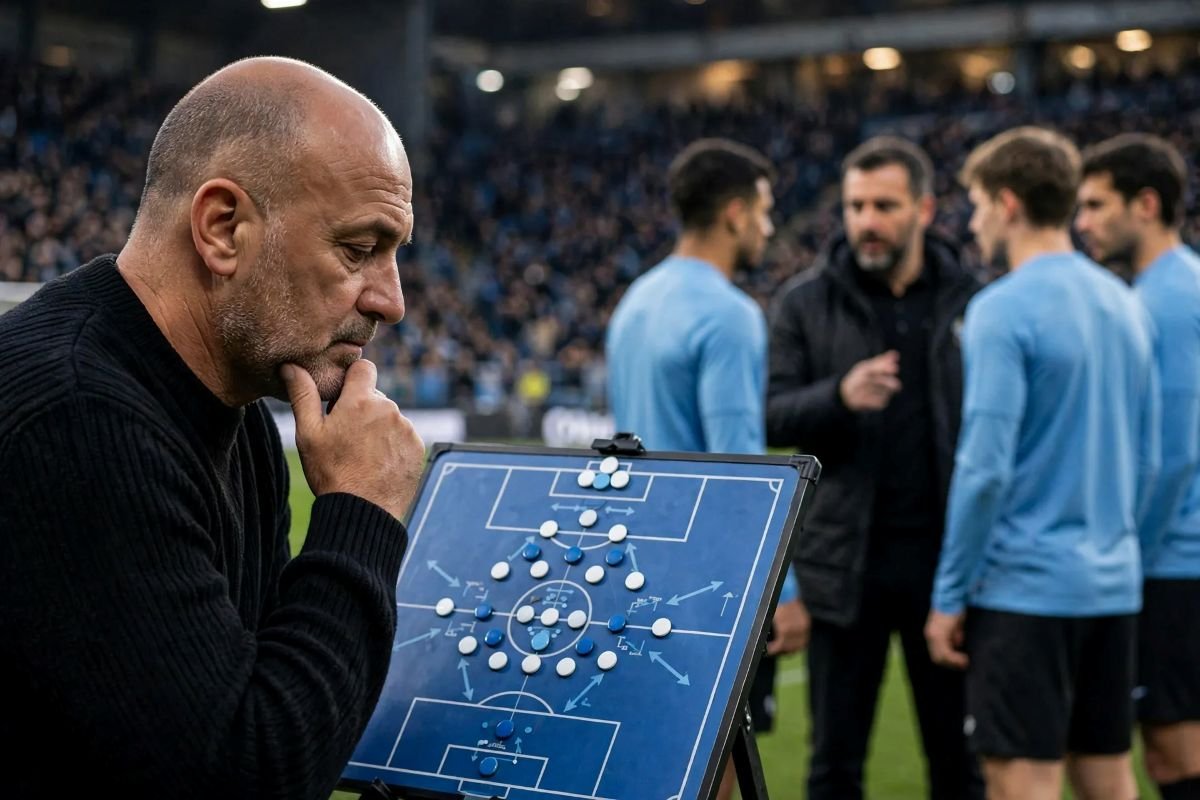
Behind Guardiola’s possession-based football is a tactical concept known as positional play, or Juego de Posición.
At its simplest, positional play involves organizing players across different areas of the pitch to create useful passing options, maintain appropriate distances, and make it difficult for opponents to defend every available space.
However, it is much more sophisticated than simply telling players to stay in their assigned positions.
Imagine a team attacking against an opponent defending with two compact lines. If several attacking players occupy the same central area, the defenders can concentrate their attention on a relatively small space.
But if the attacking team spreads its players intelligently across the pitch, the defensive structure becomes more difficult to maintain.
A midfielder may position himself between the opposition’s defensive and midfield lines. A winger stays wide to stretch the defense. Another player moves into an inside channel, creating an additional passing option.
These positions force defenders to make decisions.
If a defender moves forward to challenge the midfielder, space may appear behind him. If the defensive line remains compact, the attacking team may find an opportunity to switch play toward the opposite wing.
This is the essence of positional play: using intelligent positioning to create numerical, positional, and spatial advantages.
Guardiola’s teams often appear to play a game of chess because their movements are connected. One player moves to attract an opponent, another occupies the space that has been created, and a third provides an alternative passing option.
The ball moves because the players understand where they need to be.
This does not mean that players remain permanently inside fixed zones. Rotations, overlapping runs, underlapping movements, and changes of position are essential parts of the system.
The important principle is that these movements should maintain the team’s overall structure rather than create unnecessary congestion.
This also explains why Guardiola values technically intelligent players so highly. A player must understand not only how to receive and distribute the ball but also how his position affects the movements of everyone around him.
A simple pass can become extremely valuable when it eliminates an opponent from the defensive structure or opens a route toward the penalty area.
The most important work in Guardiola’s football often happens before the ball reaches the player who eventually creates the scoring opportunity.
That is why watching his teams requires looking beyond the player in possession.
WHY 70% POSSESSION CAN STILL END IN DEFEAT
Possession statistics can be impressive, but they do not tell the entire story of a football match.
A team may control 70 percent of the ball and still struggle to create clear chances. It may complete hundreds of accurate passes without finding a way through a well-organized defensive structure.
This happens because possession and attacking effectiveness are not the same thing.
Consider an opponent that defends with a deep defensive block. Its players remain compact, protect the central areas, and allow the attacking team to circulate possession in less dangerous positions.
The team with the ball may dominate the statistics, but every attempt to penetrate the defense becomes difficult.
Meanwhile, the defending team waits for an opportunity to recover possession and attack the space left behind.
One successful interception, one accurate forward pass, and one decisive finish can completely change the result.
This is particularly dangerous against teams that possess fast attacking players and understand how to exploit transitions.
Guardiola has experienced this challenge throughout his managerial career. His teams have suffered important defeats despite enjoying considerable possession, demonstrating that statistical dominance does not guarantee a positive result.
There is another important tactical problem: predictable possession.
If a team repeatedly passes sideways without moving opponents or penetrating defensive lines, the opposition can maintain its structure without facing serious danger.
The solution is not necessarily to abandon possession. It is to make possession more purposeful.
Sometimes the best decision is a quick forward pass. Sometimes a long ball behind the defensive line is more effective than another sequence of short passes. At other moments, a winger must attempt an individual dribble to disrupt an organized defense.
Modern football requires different attacking solutions, even within a possession-based philosophy.
This is one reason Guardiola has continued adapting his teams.
THE STATISTICS BEHIND GUARDIOLA’S POSSESSION-BASED FOOTBALL
Guardiola’s managerial career provides an interesting opportunity to examine the relationship between possession and major trophies.
His teams have consistently been associated with high possession percentages, but their achievements have varied depending on the competition, squad, and tactical environment.
The following table summarizes the broad historical picture. The possession percentages are indicative figures rather than a standardized career-wide calculation; exact averages vary according to the seasons included and the statistical provider. League titles are counted within the specified managerial periods.
Pep Guardiola’s teams: possession and major achievements
| Team | Seasons | Approx. average possession | League titles | Champions League |
|---|---|---|---|---|
| Barcelona | 2008–2012 | 68% | 3 | 2 |
| Bayern Munich | 2013–2016 | 66% | 3 | 0 |
| Manchester City | 2016–2024 | 65% | 6 | 1 |
Source: Statistics compiled from FBref, UEFA, and official club records from FC Barcelona, Bayern Munich, and Manchester City.
These achievements reveal an important distinction.
At Barcelona, Guardiola won three La Liga titles and two Champions League trophies. His team became one of the most influential sides in modern football history.
At Bayern Munich, he won three consecutive Bundesliga championships between 2014 and 2016, but did not win the Champions League. The German club reached the semi-finals in all three of his seasons in charge.
At Manchester City, Guardiola eventually led the club to six Premier League titles through the 2023–24 season and its first Champions League championship in 2023.
Across Barcelona and Manchester City, he has won three Champions League titles as a manager. His time at Bayern produced significant domestic success but no European championship.
These numbers demonstrate that possession has been a consistent feature of Guardiola’s teams, but they also reveal that success in Europe’s most demanding competition depends on many additional factors.
The Champions League involves opponents with different tactical approaches, exceptional individual players, and the ability to punish even small mistakes. A team may dominate possession for much of a match but still lose because of defensive errors, ineffective finishing, or an opponent’s outstanding performance.
Therefore, the table should not be interpreted as evidence that possession is ineffective.
Instead, it illustrates a more important lesson: possession creates advantages, but those advantages must be converted into goals and defensive security.
Statistics help us understand football, but they cannot replace tactical analysis.
FROM BARCELONA TO BAYERN TO MANCHESTER CITY: THE MANAGER WHO NEVER STOPPED CHANGING
Perhaps Guardiola’s most impressive quality is not his commitment to possession but his willingness to adapt his philosophy to different players and footballing environments.
His approach at Barcelona was different from his approach at Bayern Munich, and Manchester City eventually developed its own distinctive characteristics.
Barcelona: The perfection of technical possession
At Barcelona, Guardiola inherited a team with extraordinary technical quality and built a system around players who understood one another almost instinctively.
Xavi controlled the rhythm of possession, Iniesta created opportunities through intelligent movement and close control, Busquets provided balance, and Messi became the central attacking force.
Their football combined patient passing with sudden acceleration. The team could maintain possession for long periods before finding a decisive pass that broke through the opposition.
The 2009 and 2011 Champions League victories demonstrated how effective this approach could become when executed by technically exceptional players.
Bayern Munich: Greater emphasis on width and attacking variety
At Bayern, Guardiola inherited a squad with different strengths and a different footballing culture.
He made extensive use of wide attacking players, particularly Arjen Robben and Franck Ribéry, whose dribbling and individual creativity provided additional ways to break down defensive structures.
His tactical experiments also involved different midfield configurations and flexible defensive arrangements.
Rather than copying Barcelona, he adapted positional play to the qualities of his Bayern squad.
Manchester City: Combining possession with a powerful goalscoring threat
At Manchester City, Guardiola continued evolving his philosophy.
The arrival of Erling Haaland in 2022 provided the team with an exceptional central goalscorer. Haaland’s movement, physical presence, speed, and finishing ability offered a different attacking dimension.
Players such as Kevin De Bruyne could now deliver passes into the spaces Haaland attacked, while the team’s possession structure helped create opportunities around the penalty area.
The result was a more varied attacking approach. City could patiently build attacks, but it could also exploit space quickly and deliver the ball directly into dangerous areas.
The club’s historic treble in the 2022–23 season, including its first Champions League title, demonstrated the effectiveness of this evolving approach.
Guardiola’s philosophy is not about forcing every team to play in exactly the same way. It is about finding the most effective way to control matches with the players available.
WHAT MAKES GUARDIOLA DIFFERENT FROM OTHER GREAT MANAGERS?
Many successful managers have developed recognizable tactical identities. Some prioritize defensive organization, others prefer rapid counterattacks, while some build their teams around physical strength and direct attacking football.
Guardiola’s distinction lies in the depth of his attention to detail.
He studies how opponents defend, where spaces appear, how players receive the ball, and how small positional adjustments can change an entire attacking sequence.
His teams are expected to understand the relationship between every movement and the overall structure.
This can sometimes make their football appear almost mechanical.
The passing patterns are carefully organized, the players maintain specific distances, and the team attempts to minimize unnecessary risks.
But this does not mean Guardiola’s football lacks creativity.
Messi’s dribbling, Iniesta’s movement, De Bruyne’s passing, and Bernardo Silva’s ability to operate in tight spaces all demonstrate the importance of individual imagination within a structured system.
In fact, tactical organization can create more opportunities for creativity by giving players a better understanding of the spaces available to them.
The greatest challenge is maintaining the balance between structure and freedom.
Too much freedom can make a team disorganized. Too much structure can make it predictable.
Guardiola’s career has been a continuous attempt to find that balance.
MY PERSONAL FEELING: WHY I ADMIRE PEP BUT DO NOT ALWAYS ENJOY HIS FOOTBALL
Personally, I admire Pep Guardiola enormously, but I do not always find his teams the most entertaining to watch.
Sometimes, their football feels almost too perfect, as if every movement has been calculated in advance. The passing is precise, the positioning is organized, and the players appear to understand exactly where they need to be.
I understand why so many people admire this approach, but I also enjoy another side of football.
I love unexpected moments, individual improvisation, emotional celebrations, mistakes that completely change a match, and counterattacks that develop before anyone has time to react.
There is something beautiful about football’s unpredictability. Not every match needs to be tactically perfect to become unforgettable.
However, I have to admit that watching Guardiola’s teams has changed the way I understand the sport.
Previously, I naturally followed the player with the ball. I focused on the dribbler, the passer, or the person preparing to shoot.
Now, I pay much more attention to what happens away from the ball.
I watch how a midfielder moves to create a passing lane. I notice how a winger stays wide to stretch the defensive line. I observe how a forward attracts a defender and creates space for a teammate.
Sometimes, the most important action in an attacking sequence happens several seconds before the ball reaches the player who scores.
That realization has made football even more fascinating.
Guardiola taught me that the beauty of football is not always found in the final pass or the goal. Sometimes, it exists in the intelligence of a movement that most people never notice.
CONCLUSION: THE GREATEST LESSON PEP GUARDIOLA HAS GIVEN MODERN FOOTBALL
Pep Guardiola’s greatest contribution to football cannot be measured simply through possession percentages, passing records, or the number of trophies in his collection.
His influence comes from the way he has encouraged teams, players, and supporters to think differently about the relationship between possession, space, movement, and control.
Barcelona demonstrated how technical quality and positional play could dominate European football. Bayern Munich showed how those principles could be adapted to a different squad and footballing culture. Manchester City demonstrated how possession-based football could evolve to incorporate different attacking profiles and more direct solutions.
His teams have not won every match, and their possession statistics have never guaranteed victory. But that is precisely why his philosophy deserves to be examined beyond the numbers.
Possession is not victory. Passing is not creativity. Controlling the ball is not necessarily the same as controlling the game.
The real challenge is knowing what to do with possession, how to create space, when to accelerate, and how to prevent the opponent from taking advantage of your mistakes.
I may not always prefer Guardiola’s style over more unpredictable and emotional forms of football. Nevertheless, his influence has taught me to appreciate something I previously overlooked: the intelligence hidden behind every movement.
Perhaps that is his greatest achievement.
He has not only changed the way many teams play football. He has changed the way millions of people watch, understand, and appreciate the game.