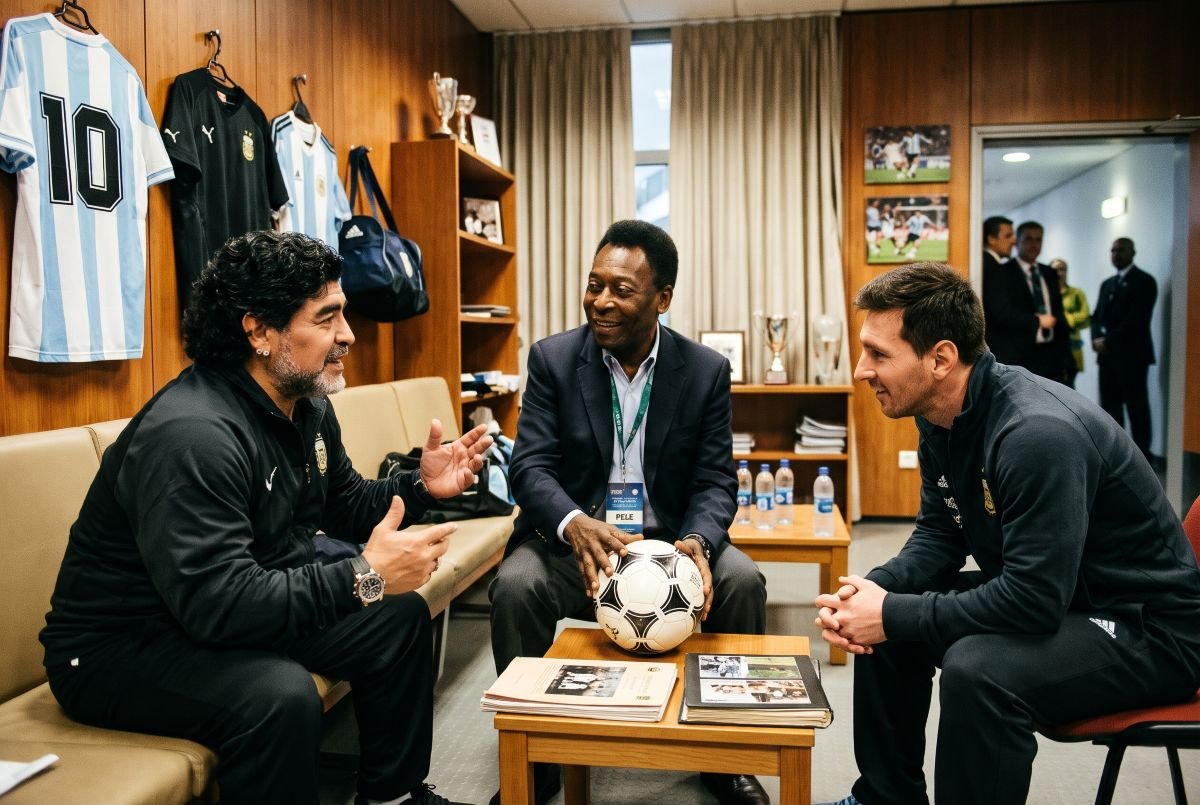
THREE LEGENDS, THREE FOOTBALLING REVOLUTIONS: HOW PELÉ, MARADONA AND MESSI CHANGED THE GAME FOREVER
Few debates in football history have generated as much passion as the question of who deserves to be called the greatest player of all time. Pelé, Diego Maradona, and Lionel Messi are three names that almost always dominate this discussion. Each represents a different generation, each achieved extraordinary success, and each left a legacy that continues to influence how people understand the beautiful game.
Supporters often compare their goals, trophies, individual awards, and performances in the biggest competitions. Some believe Pelé stands above everyone because of his three World Cup victories. Others argue that Maradona’s extraordinary influence on Argentina and Napoli makes him the most remarkable individual talent football has ever seen. Meanwhile, Messi’s supporters point to his incredible consistency, technical brilliance, and eventual World Cup triumph in 2022.
But perhaps the question of who was the best is not the most interesting one.
What makes these three players truly extraordinary is that they changed football in three very different ways. Pelé helped turn footballers into global icons, Maradona demonstrated how one exceptional individual could transform an entire team’s fortunes, and Messi redefined the expectations of consistency, creativity, and technical excellence.
Their stories are not simply about winning trophies. They are about how individual greatness can influence an entire sport.
1. PELÉ: THE LEGEND WHO HELPED MAKE FOOTBALL A GLOBAL PHENOMENON
Born Edson Arantes do Nascimento in Três Corações, Brazil, in 1940, Pelé emerged during a period when football was already deeply established in Europe and South America. However, international television coverage was still developing, and the world’s greatest players were not as accessible to global audiences as they are today.
Pelé helped change that relationship between football and the rest of the world.
His extraordinary rise began at Santos, where his technical ability, creativity, movement, and remarkable finishing quickly attracted international attention. At just 17 years old, he became one of the central figures in Brazil’s victory at the 1958 FIFA World Cup in Sweden.
His performances were extraordinary for someone so young. He scored twice in the final against Sweden, helping Brazil secure its first World Cup championship and introducing international audiences to a player who seemed capable of doing almost anything with a football.
But the 1958 tournament was only the beginning.
Pelé won another World Cup in 1962 and completed his remarkable achievement in 1970, becoming the only player in men’s football history to win three FIFA World Cup titles.
The Brazilian team of 1970 remains one of the most celebrated sides ever assembled. Alongside Pelé were extraordinary players such as Jairzinho, Rivellino, Gérson, Tostão, and Carlos Alberto. Their combination of technical quality, intelligent movement, and attacking creativity produced football that continues to inspire supporters and coaches.
Pelé was at the center of that team. He could score, create opportunities, connect attacking movements, and influence the rhythm of a match. His understanding of space and ability to anticipate situations made him much more than an ordinary goalscorer.
His influence also extended beyond the international stage.
During his years at Santos, the club became an internationally recognized team, with overseas tours introducing Brazilian football to audiences across different continents. Pelé’s popularity helped establish him as one of the first truly global sporting superstars.
In 1975, he joined New York Cosmos in the United States. His arrival attracted enormous attention and contributed to growing interest in football in a country where the sport was still developing its popularity.
This was an important part of his historical influence.
Before the modern era of social media, international sponsorships, and worldwide television coverage, Pelé demonstrated that a footballer could become a recognizable personality far beyond the stadium.
He was not simply a Brazilian football star. He became one of the most recognizable ambassadors of the sport in the world.
Pelé’s greatest contribution was therefore not limited to his three World Cup medals. He helped introduce generations of people to the beauty of football and demonstrated how the sport could connect different countries, cultures, and communities.
2. MARADONA: THE GENIUS WHO SHOWED HOW ONE PLAYER COULD TRANSFORM A TEAM
If Pelé helped expand football’s international appeal, Diego Maradona demonstrated the extraordinary influence one player could have on a team’s identity, confidence, and ambitions.
Born in Lanús, Argentina, in 1960, Maradona grew up in Villa Fiorito, a working-class neighborhood on the outskirts of Buenos Aires. Football became an important part of his life from an early age, and his extraordinary talent quickly attracted attention.
Maradona’s playing style was unlike that of almost anyone else.
His low center of gravity, exceptional balance, close ball control, and explosive acceleration allowed him to move through crowded defensive areas with remarkable precision. He could receive the ball under pressure, escape several opponents, and create attacking opportunities from situations that appeared almost impossible.
But his greatest quality was not simply his ability to dribble.
Maradona frequently took responsibility for organizing his team’s attacks. He could move deeper into midfield, collect possession, create passing opportunities, and influence the entire rhythm of a match.
His most famous international achievement came at the 1986 FIFA World Cup in Mexico.
Argentina entered the tournament with a talented squad, but Maradona became the central figure in their journey toward the championship. He scored five goals and provided five assists, producing one of the most influential individual World Cup campaigns in history.
The quarter-final against England became one of football’s most unforgettable matches.
Maradona scored twice, producing two goals that revealed completely different sides of his legacy.
The first was the controversial Hand of God goal, scored through a handball that the officials failed to detect. The second, however, was an extraordinary demonstration of individual ability.
Collecting the ball inside his own half, Maradona accelerated through the English defense, passed several opponents, and finished with remarkable composure. The goal is widely regarded as one of the greatest individual goals ever scored.
Argentina eventually defeated West Germany 3–2 in the final, with Maradona providing the assist for Jorge Burruchaga’s winning goal.
However, his influence was not limited to the national team.
His achievements at Napoli became another defining chapter of his career. When Maradona arrived in Naples in 1984, the club had never won the Italian Serie A championship. Italian football was dominated by financially powerful and historically successful teams, particularly from the northern part of the country.
Under his influence, Napoli won its first Serie A title in 1987 and secured another in 1990. The club also won the UEFA Cup in 1989.
For the people of Naples, these victories represented much more than sporting success. They became a source of regional pride and demonstrated that a club outside the traditional centers of Italian football could challenge the established powers.
Maradona became a symbol of that transformation.
His career also contained controversies, personal difficulties, and periods of struggle. These realities should not be ignored when discussing his legacy. In many ways, they made his story more complicated and helped explain why supporters developed such a powerful emotional connection with him.
Maradona showed that football could represent much more than winning matches. It could become a symbol of identity, pride, hope, and the belief that extraordinary achievements were possible.
3. MESSI: THE PLAYER WHO REDEFINED CONSISTENCY AND FOOTBALL INTELLIGENCE
Several decades after Pelé and Maradona established their places in football history, Lionel Messi emerged as a player who would redefine expectations of individual excellence in the modern game.
Born in Rosario, Argentina, in 1987, Messi joined Barcelona’s youth academy in 2000 before making his first-team debut in 2004.
From his earliest appearances, his technical ability was immediately apparent. His close control, acceleration, balance, and ability to change direction made him exceptionally difficult for defenders to stop.
However, what separated Messi from many other talented players was his ability to develop and adapt his game over time.
During his early career, he was primarily recognized for his extraordinary dribbling and ability to beat opponents in one-on-one situations. As his experience increased, he developed into a much more complete attacking player.
He could operate as a forward, drop deeper into midfield, create opportunities, control possession, and deliver decisive passes. Rather than concentrating exclusively on scoring goals, Messi increasingly became someone capable of influencing almost every stage of an attacking movement.
His partnership with Pep Guardiola at Barcelona was particularly important in demonstrating this evolution.
Between 2008 and 2012, Barcelona developed one of the most influential tactical systems in modern football. Built around possession, positional awareness, intelligent movement, and coordinated pressing, the team established a style that influenced clubs and coaches around the world.
Messi became the central attacking figure in that system.
He could receive the ball between defensive lines, move into central areas, create numerical advantages, and finish attacks with remarkable precision. His ability to combine goalscoring with playmaking made him extremely difficult to defend against.
His achievements at club level became extraordinary. He won numerous domestic and international trophies with Barcelona, including four UEFA Champions League titles. He also collected eight Ballon d’Or awards, establishing himself as one of the most decorated individual players in football history.
But perhaps his most remarkable achievement was maintaining such a high standard across multiple generations of football.
Many players experience a short period of extraordinary success before their performances decline. Messi, however, continued to produce outstanding performances across different managers, teammates, tactical systems, and competitions.
He also helped change how people understood the role of an attacking player.
Traditionally, a forward was often expected to concentrate primarily on scoring goals. Messi demonstrated that one player could simultaneously become a goalscorer, creative playmaker, and organizer of attacking movements.
Young footballers around the world began studying this combination of abilities. They wanted to develop not only their finishing but also their passing, vision, movement, and understanding of the game.
Nevertheless, one important achievement remained central to discussions about Messi’s international legacy: the World Cup.
After reaching the final in 2014 and losing to Germany, Messi experienced years of disappointment and intense debate about his achievements with Argentina.
That chapter finally changed in Qatar in December 2022.
At the 2022 FIFA World Cup, Messi captained Argentina to the championship after an unforgettable tournament. Argentina defeated France in the final following a 3–3 draw, eventually winning the penalty shootout 4–2.
Messi scored twice in the final and finished the competition with seven goals. He also received the Golden Ball as the tournament’s best player.
For Argentina, the victory ended a 36-year wait for another men’s World Cup championship. For Messi, it represented the fulfillment of a lifelong ambition.
His greatest legacy is not simply the number of goals he scored or trophies he collected. It is the extraordinary ability to maintain excellence while continuously evolving as a footballer.
4. PELÉ VS MARADONA VS MESSI: WHAT DO THE NUMBERS REALLY TELL US?
Statistics provide an interesting starting point when comparing three players from different generations. However, they must be interpreted carefully because football has changed considerably over the decades.
The methods used to record goals, evaluate performances, and recognize individual achievements were not identical throughout their careers.
Statistics table: Pelé vs Maradona vs Messi
| Player | World Cup Titles | Career Goals | Professional Era | Ballon d’Or |
|---|---|---|---|---|
| Pelé | 3 | 1,281 often cited, including friendlies | 1956 to 1977 | Not eligible for the official award |
| Maradona | 1 | Around 300, depending on counting criteria | 1976 to 1997 | Not eligible for the official award |
| Messi | 1 | 900 plus official senior goals | 2004 to present | 8 |
Note: Career goal totals vary depending on whether friendly, exhibition, and unofficial matches are included. The figures should not be treated as directly comparable.
Source: Historical statistics compiled from FIFA, RSSSF, and official club records.
These numbers reveal several important differences.
Pelé’s three World Cup championships remain an extraordinary achievement. His international success placed him among the most influential figures in the history of the competition.
Maradona’s 1986 campaign demonstrated how one exceptional player could become the creative center of a championship-winning team. His five goals and five assists during that tournament remain particularly important when evaluating his individual influence.
Messi’s statistics demonstrate another form of greatness. His extraordinary goalscoring record, eight Ballon d’Or awards, four Champions League titles, and 2022 World Cup triumph reflect a career of remarkable longevity and achievement.
There is also an important historical detail concerning the Ballon d’Or.
Pelé and Maradona did not win the official Ballon d’Or because the award originally restricted eligibility to European players. The eligibility rules were gradually expanded, first to include players of other nationalities playing for European clubs in 1995, and eventually to include players worldwide in 2007.
Both Pelé and Maradona later received honorary recognition through the FIFA Ballon d’Or Prix d’Honneur in 2013.
Therefore, comparing their official Ballon d’Or totals with Messi’s eight awards without considering the historical restrictions would be misleading.
Another common misconception is that Pelé enjoyed only ten years at the highest level or that Maradona was great for just five or six years. Both had careers spanning more than two decades, although their periods of peak performance were different.
Statistics can describe greatness, but they cannot fully explain the historical influence, playing style, or emotional importance of these three extraordinary players.
5. SO, WHO CHANGED FOOTBALL THE MOST?
Looking at their careers together reveals three different forms of influence.
Pelé helped make football a global cultural phenomenon. Through his World Cup achievements, international recognition, and influence beyond the pitch, he became one of the first footballers to achieve worldwide celebrity.
Maradona demonstrated the power of individual brilliance. His performances at the 1986 World Cup and his achievements with Napoli showed how one exceptional player could transform a team’s ambitions and become an enduring symbol of an entire community.
Messi redefined the modern standard of sustained excellence. His combination of goalscoring, creativity, tactical intelligence, and consistency demonstrated how a player could influence almost every aspect of attacking football.
Their achievements also reflect the evolution of the sport.
Pelé played during a period when international television coverage was expanding. Maradona competed in an era when individual creativity frequently faced intense physical challenges. Messi developed in a footballing environment characterized by sophisticated tactical systems, advanced performance analysis, and increasingly organized defensive structures.
Each generation presented different challenges, and each player found a remarkable way to overcome them.
Perhaps this is why comparing them is so difficult. They were not competing under identical conditions, and their greatest contributions were not necessarily measured in the same way.
6. MY PERSONAL FEELING: WHY MESSI FEELS CLOSER TO ME
Personally, I admire all three players, but I feel a particularly strong connection with Lionel Messi.
Pelé feels like a legend from a storybook. His achievements belong to an extraordinary chapter of football history, and his influence is almost difficult to imagine for those who never had the opportunity to watch him play regularly.
Maradona feels like a hero from a great movie. His story contains extraordinary moments of brilliance, emotional victories, difficult struggles, and a connection with supporters that few footballers have ever experienced.
But Messi feels different to me.
I watched him grow from a young player at Barcelona into one of the greatest footballers the world has ever seen. I witnessed his extraordinary performances, his achievements, and the disappointments that followed him throughout his international career.
For years, the World Cup remained the one major achievement missing from his extraordinary collection.
Then came December 18, 2022.
When Argentina finally defeated France in the World Cup final, I felt an emotion that went beyond simply watching another football match. It was as if I had been waiting alongside him for something that had taken an entire generation to achieve.
I knew how much that victory meant to Messi and to millions of supporters who had followed his journey.
That is why his World Cup triumph was so meaningful to me.
It was not simply another trophy for an already successful footballer. It was the conclusion of a long international journey filled with expectations, criticism, disappointment, and perseverance.
Messi is special to me not only because of his extraordinary talent, but because I grew up watching his journey. His victories became part of my own memories of football.
Perhaps this is something statistics can never measure.
CONCLUSION: THREE DIFFERENT LEGACIES, ONE SPORT THAT WILL NEVER FORGET THEM
The debate between Pelé, Maradona, and Messi will probably continue for as long as football exists.
Every generation has its own memories, preferences, and standards for measuring greatness. Some supporters will always value World Cup success above everything else. Others will prioritize individual brilliance, technical ability, longevity, or the ability to transform an entire team.
There is no universally accepted formula that can produce one definitive answer.
But perhaps that is exactly what makes this discussion so valuable.
Pelé helped the world fall in love with football. Maradona showed how deeply one player could influence a team and a nation. Messi demonstrated that extraordinary talent could be sustained through intelligence, adaptability, and remarkable consistency.
Three legends. Three generations. Three different revolutions.
They did not change football in the same way, and that is precisely why their legacies deserve to be celebrated individually.
Perhaps the greatest achievement of these three players is not that they gave football one definitive answer to the question of who is the best, but that they gave millions of people different reasons to love the same beautiful game.
And long after the final whistle of their careers, their influence will continue to shape how future generations play, watch, and understand football.