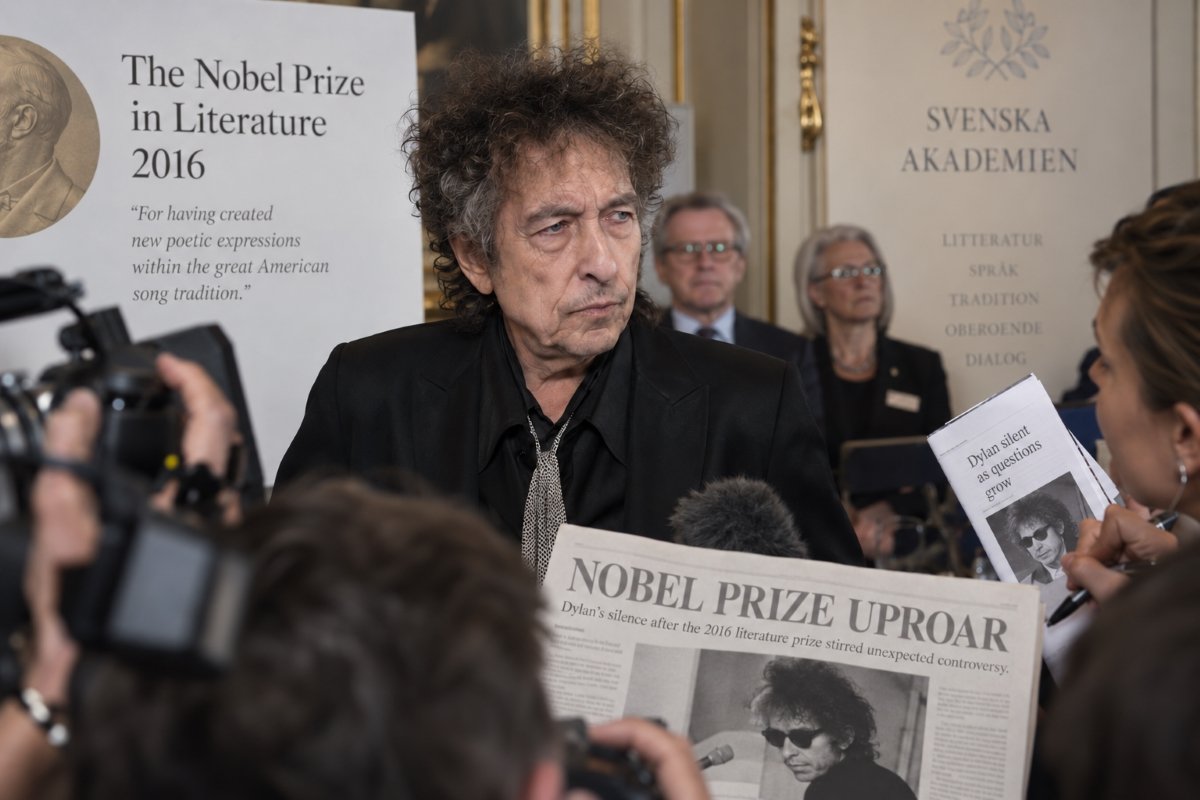
BOB DYLAN’S NOBEL PRIZE UPROAR: THE SILENCE THAT SPARKED AN “IMPOLITE AND ARROGANT” BACKLASH
When Bob Dylan won the 2016 Nobel Prize in Literature, the announcement offered an extraordinary moment of recognition for songwriting. An artist whose words had accompanied generations of listeners was receiving an honor associated with some of the world’s most celebrated authors. Yet the celebration soon developed an unexpected complication: Dylan himself remained silent.
For admirers who had followed his career through decades of reinvention, that silence was intriguing. For others, it seemed difficult to understand. How could someone receive such a distinguished award without promptly acknowledging it? Before long, the conversation shifted from the significance of his songs to the meaning of his absence from the discussion.
The award was announced on October 13, 2016. More than a week later, Dylan had offered no public response, and attempts to establish contact had become part of the news. Swedish Academy member Per Wästberg then described his behavior as “impolite and arrogant.” Those words gave the unfolding story a sharper edge. What might otherwise have remained an unusual delay became a controversy about courtesy, celebrity, and expectations. Time
One distinction matters: the criticism came from an individual Academy member. It should not be presented as a collective verdict from everyone involved in awarding the prize. Nevertheless, the comment was powerful enough to shape headlines and color the public understanding of Dylan’s response.
The dispute also raised a familiar problem in the relationship between artists and their audiences. A public honor comes with an unwritten script: express surprise, offer thanks, pose for photographs, and acknowledge the institution responsible. When the recipient does not immediately follow that script, observers begin supplying explanations of their own.
But silence does not provide reliable access to someone’s intentions. It can be interpreted as indifference, discomfort, hesitation, or defiance. Without further evidence, none of those interpretations becomes a fact. The most dramatic explanation may attract the most attention, but it does not necessarily bring readers closer to understanding what happened.
By October 28, the story had changed. Dylan publicly acknowledged the honor, expressing amazement and indicating that he accepted it. He explained that the news had left him “speechless.” That response complicated the assumption that his earlier silence amounted to contempt. His own account conveyed surprise and appreciation rather than a rejection of the award. Time
For readers who remembered hearing Dylan’s early records, the episode had an almost peculiar intimacy. A voice they had listened to for decades was suddenly being examined for what it had failed to say. The songs had always invited interpretation; now, even a delayed acknowledgment seemed to demand one.
The controversy continued when Dylan did not attend the December ceremony in Stockholm, citing pre-existing commitments. However, he sent a speech that was read at the Nobel banquet by Azita Raji, the United States ambassador to Sweden. During the award ceremony, Patti Smith performed “A Hard Rain’s A-Gonna Fall.” Dylan later received his medal and diploma at a private meeting with Academy members in Stockholm in April 2017. These events make the outcome clear: he accepted the Nobel Prize. 2016 Nobel Prize in Literature
His banquet speech provided a more thoughtful response than the early headlines might have suggested. Dylan expressed gratitude and reflected on the remarkable company he had joined. He also considered the practical concerns of making art, drawing a connection with Shakespeare’s work for the stage. Rather than claiming that literary prestige had always been his ambition, he described a creative life centered on writing songs and bringing them to listeners. Time
That perspective helps explain why the episode remains interesting beyond its most quoted insult. The controversy brought artistic achievement and public ceremony into uneasy contact. An institution could recognize the importance of a body of work, but it could not determine how quickly or conventionally its creator would respond.
Readers may reasonably disagree about Dylan’s handling of the announcement. Some will regard a prompt acknowledgment as simple courtesy. Others will place greater weight on his eventual expressions of gratitude. Neither position requires pretending that the delay never happened or turning it into proof of a motive that has not been established.
What endures is a story more complicated than a celebrity refusing an honor. Dylan’s silence provoked criticism, his eventual response expressed appreciation, and he accepted the prize. The episode became memorable because those developments did not arrive in the order the public expected.
For a brief period, one of the most celebrated writers of words in popular music became the subject of international attention for offering none. When he finally spoke, the answer was quieter—and more appreciative—than the uproar surrounding him.
VIDEO