BOB DYLAN’S GREAT RETREAT: THE 1966 ACCIDENT, THE UNANSWERED QUESTIONS, AND THE LIFE BEHIND THE LEGEND
In 1966, Bob Dylan stood at the center of a musical revolution. His songs challenged familiar ideas, his changing sound divided audiences, and his every move seemed to invite interpretation. Then came a motorcycle accident—and a retreat from public life that would become one of the most discussed turning points in his career.
For listeners who remember those years, the fascination is understandable. Here was an artist whose voice seemed inseparable from the times, suddenly stepping away from the stage. What had happened to the man so many people believed spoke for them? And why did his withdrawal leave such a lasting sense of mystery?
The answer requires looking beyond the temptation of a single dramatic explanation. An accident, the pressures of celebrity, and the pull of family life all belong to the story. Reducing that period to an unproven claim about addiction obscures more than it reveals.
By the time of his 1966 tour, Dylan’s move toward electric music had become a public confrontation over artistic freedom. Some listeners welcomed the change; others believed he had abandoned the folk tradition that first brought him recognition. Concerts became occasions for argument as well as performance, placing him under intense scrutiny.
There is something revealing about that response. Audiences can develop a powerful attachment to the version of an artist they first loved. A song becomes part of a personal memory, and its creator begins to feel familiar. When that artist changes direction, disappointment can feel strangely personal.
For Dylan, that tension placed an extraordinary burden on the ordinary act of making music. His artistic choices were being treated as declarations about what he owed his audience.
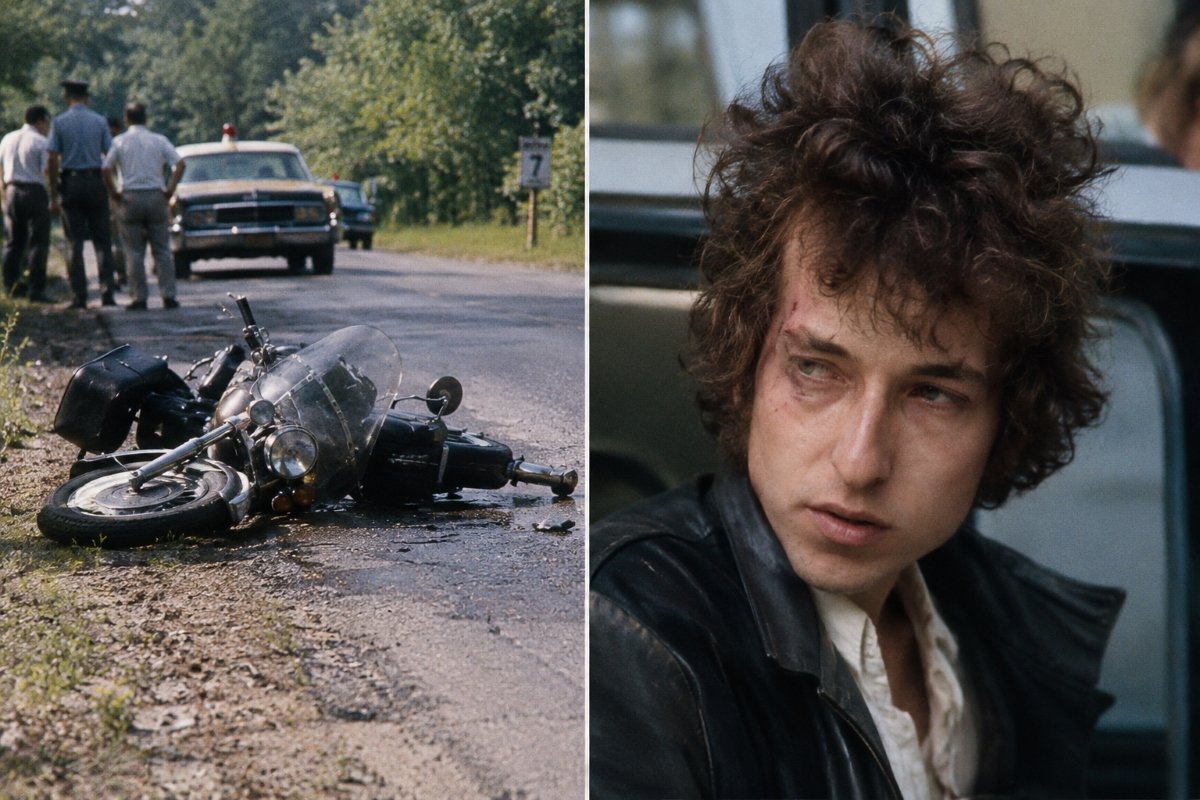
Then, on July 29, 1966, Dylan was involved in a motorcycle accident near Woodstock, New York. It became the dividing line between his relentless public activity and a much quieter existence. In his later memoir, Chronicles: Volume One, he acknowledged being injured but also explained that he had wanted to escape the exhausting cycle of his professional life.
That distinction matters. Recovering from an accident and reconsidering a way of life can happen together. His own explanation gives the withdrawal a human dimension that the surrounding mythology sometimes overlooks.
For readers who have lived through demanding careers, raised children, or reconsidered their priorities after an unexpected setback, that impulse may seem familiar. There are moments when continuing at the same pace stops feeling like ambition and begins to feel like surrendering control of one’s days.
Dylan later described how profoundly having children changed his life. His retreat allowed family to occupy a place that public expectations had made difficult to protect. This was a period of fewer appearances and greater distance from the role others had assigned him.
Yet his withdrawal from the spotlight did not mean the end of his creativity.
During 1967, Dylan made informal recordings with the musicians who would become known as the Band. Sessions took place at his home and at Big Pink, a house near Woodstock. The recordings eventually became associated with The Basement Tapes, offering evidence of musical work continuing away from the usual machinery of public performance.
That activity changes how we should understand the word “disappearance.” From the audience’s perspective, Dylan had become difficult to see. From a musical perspective, he remained engaged. The stage lights had dimmed, but the work continued.
Later in 1967, he recorded John Wesley Harding, another sign that the period following the accident was also a period of artistic development. His career had changed its rhythm, rather than simply stopped.
The enduring mystery comes partly from the distance between those two experiences: what the public could observe and what an artist could accomplish privately.
It is tempting to fill that distance with the most sensational explanation available. But privacy does not supply evidence for a diagnosis, and unanswered questions do not establish a hidden cause. Claims that addiction definitively explains Dylan’s retreat should not be presented as settled fact.
What makes this chapter compelling is already there in the documented story: a celebrated musician facing fierce expectations, an accident that interrupted his momentum, and a decision to place greater distance between his life and his public image.
Perhaps the most useful question is what his retreat asks of the rest of us. How much access does admiration entitle an audience to demand? Can we value an artist’s work while accepting that parts of the life behind it remain beyond our reach?
For those who have carried Dylan’s songs through the decades, his music offers a lasting connection. His private life need not be fully explained for that connection to matter.
After 1966, Bob Dylan became less available to the public—but the music kept coming. That is the revealing fact at the heart of his great retreat: stepping away from constant attention left room for another chapter to begin.