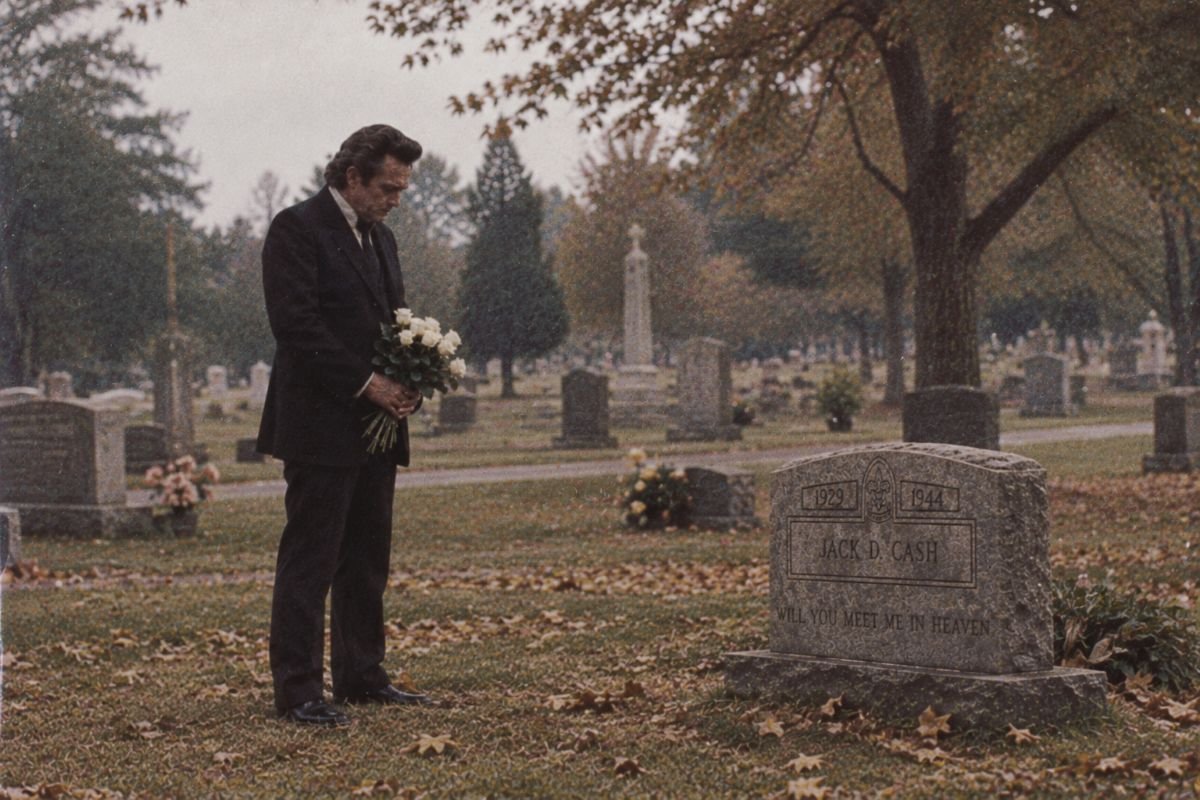
THE HEARTBREAKING TRAGEDY THAT SHAPED JOHNNY CASH: THE LOSS OF HIS BELOVED BROTHER JACK — A CHILDHOOD LOSS THAT LEFT A LASTING MARK ON THE MAN BEHIND THE MUSIC
Before Johnny Cash became The Man in Black, before the hit records, prison concerts, television appearances, and international fame, he was a young boy growing up in a poor farming family in Arkansas.
And one of the most important people in his early life was his older brother, Jack Cash.
Johnny and Jack grew up together in the Cash family’s home in the Dyess Colony. Jack was older and was remembered by Johnny as a hardworking, deeply religious young man who took his responsibilities seriously. For Johnny, his older brother represented much more than a sibling. He was someone he admired and looked up to.
Then, in 1944, tragedy struck.
Jack was working with his father and other family members when he suffered a terrible accident involving a table saw. He was severely injured and died several days later, on May 20, 1944.
Johnny was only twelve years old.
The loss was devastating.
For a child, the death of a beloved brother can be almost impossible to understand. One day someone is there—working, talking, laughing, sharing everyday family life—and suddenly that person is gone.
Johnny carried that grief with him.
According to accounts of his childhood, Jack had been an important influence on him. Jack was interested in becoming a minister and had a strong religious faith. His death therefore represented not only the loss of a brother but also the loss of someone Johnny had admired deeply.
The tragedy became one of the defining experiences of his youth.
In later years, Johnny Cash repeatedly spoke about Jack and the effect his death had on him. He remembered his brother’s kindness and his aspirations, and the memory remained an important part of his personal story.
But another painful detail has become attached to the story over the years.
The phrase “I wish it had been you” is sometimes presented in popular retellings as something Johnny’s father said to him following Jack’s death. Because accounts of the exact circumstances and wording vary, it is important not to treat that quotation as unquestionably documented without a reliable primary source.
Nevertheless, the broader story of Johnny’s grief is well established.
He had lost his brother.
He had been only a child.
And he spent the rest of his life remembering him.
That loss also became intertwined with Johnny’s understanding of mortality.
Music eventually gave him a way to process some of the emotions that followed.
Cash’s later songs frequently explored death, faith, regret, redemption, loneliness, and the meaning of a person’s life. It would be too simple to claim that every song he wrote was directly caused by Jack’s death, but the themes that appeared throughout his career clearly reflected an artist who had spent much of his life thinking about loss.
Jack’s memory remained especially connected to Johnny’s religious identity.
The young Jack had hoped to become a minister, and his faith made a lasting impression on his younger brother. Johnny himself wrestled with questions of faith throughout his life, sometimes moving closer to it and sometimes struggling with doubt and personal weakness.
That complicated relationship with belief became one of the most important elements of his music.
Cash could sing about sin and forgiveness in the same career.
He could write about despair and then turn toward hope.
He could tell stories about people who had fallen and still leave room for redemption.
Perhaps that is one reason his music resonated so deeply with people who had experienced their own hardships.
Cash understood that grief does not always disappear.
Sometimes people simply learn how to carry it.
The death of Jack happened decades before Johnny became famous, yet the memory never completely faded. Cash continued to refer to his brother in interviews and autobiographical writings, preserving Jack’s memory long after the rest of the world had largely forgotten him.
That detail is significant.
Jack never became famous.
He never had a recording career.
He never stood before enormous audiences.
But Johnny remembered him.
And through Johnny’s life and writing, Jack’s name became part of the story of one of the most famous musicians in American history.
The tragedy also occurred at a particularly important moment in Johnny’s development.
He was still a boy.
His family was living through the hardships of rural America during the 1940s. Money was limited, work was demanding, and the family depended heavily on one another.
Jack’s death changed that family forever.
For Johnny, it introduced a profound awareness that life could change in an instant.
That realization would later appear repeatedly in his artistic work.
Cash became fascinated by people facing consequences.
He wrote about prisoners whose lives had taken terrible turns.
He sang about soldiers who never returned home.
He told stories about people living with regret.
He wrote about families separated by death and circumstances.
His songs often asked what remains after someone has made a mistake, suffered a loss, or reached the end of the road.
Those themes were not simply fictional concepts.
They were part of the emotional world in which Cash had grown up.
Yet it would be unfair to portray his entire life as an attempt to compensate for his brother’s death.
Johnny Cash had many motivations: his love of music, his family, his faith, his ambitions, his experiences in the military, and his desire to communicate with audiences.
His life was far more complicated than one childhood tragedy.
Still, Jack’s death was undeniably one of the deepest losses of his early life.
And it remained one of the memories he carried into adulthood.
Years later, when Cash became a global star, the contrast was striking.
Millions of people knew Johnny Cash.
Millions knew his songs.
Millions recognized his voice.
But behind the famous name was a man who still remembered a brother who had died when he was only twelve.
That is perhaps the most moving part of the story.
Fame did not erase childhood memories.
Success did not bring Jack back.
And no amount of applause could change what had happened on that terrible day in 1944.
But Johnny could keep his brother’s memory alive.
He could speak about him.
He could remember his dreams.
And he could continue living a life in which Jack’s memory remained part of the story.
Johnny Cash eventually became one of the most influential figures in American music. He survived addiction, experienced professional setbacks, built a remarkable career, and created songs that continue to be heard decades after his death.
But the beginning of his story was much quieter.
It was a family in Arkansas.
Two brothers.
A hardworking household.
And a tragedy that changed everything.
The world would eventually know Johnny Cash as The Man in Black.
But long before that legendary figure existed, he was simply Jack Cash’s younger brother—a twelve-year-old boy trying to understand why someone he loved was suddenly gone.
Perhaps that is why the story remains so powerful.
It reminds us that behind every legend is a human being shaped by experiences that happened long before the world was watching.
Johnny Cash carried many things throughout his life: fame, faith, regret, recovery, love, and loss.
Among the memories he never abandoned was the memory of his brother Jack.
And sometimes, the people who leave the deepest marks on our lives are the ones the wider world never had the chance to know.