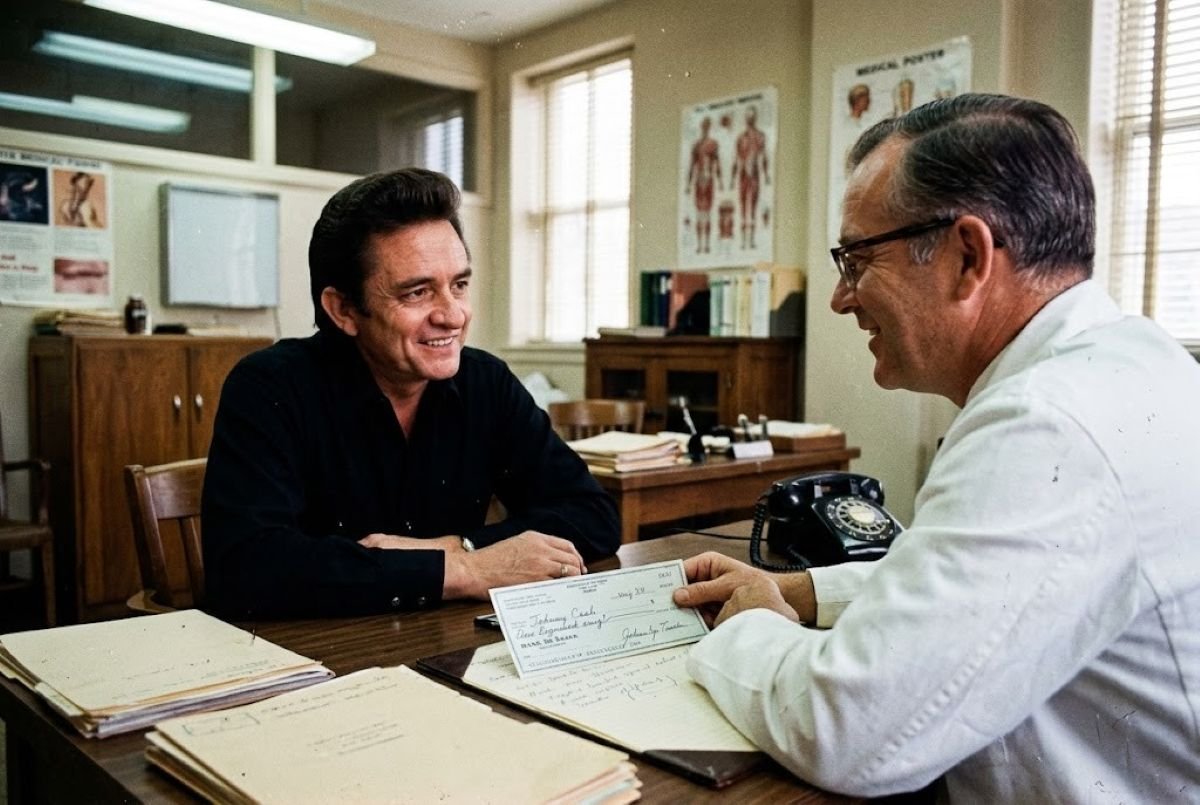
THE QUIET HEROISM OF JOHNNY CASH: BEHIND THE CONCERTS AND THE FAME, HOW HIS MUSIC BECAME A SOURCE OF HOPE FOR CHILDREN AND FAMILIES IN NEED
Johnny Cash spent much of his life standing beneath bright stage lights. Millions of people knew his deep voice, his unmistakable black clothing, and the songs that made him one of the most influential figures in American music.
But behind the fame was another side of Cash—one that was less about applause and more about compassion.
Throughout his career, Cash repeatedly used his music and public platform to draw attention to people facing difficult circumstances. He sang about prisoners, struggling families, workers, soldiers, and people who had been pushed to the margins of society. His concern for vulnerable people was not simply a theme in his songwriting. It became part of the way he understood his responsibility as a public figure.
That same spirit extended to children and families facing hardship.
Cash understood that when a child becomes seriously ill, the experience affects an entire family. Parents can suddenly find themselves dealing with fear, uncertainty, medical expenses, travel, and decisions they never expected to make.
For families facing such circumstances, hope can sometimes come from unexpected places.
A song.
A benefit performance.
A public figure willing to use his name.
Or simply the knowledge that other people care.
Johnny Cash understood the power of all three.
His career was built on the ability to connect emotionally with ordinary people. Unlike entertainers whose public image depended primarily on glamour, Cash often presented himself as someone who understood hardship.
That authenticity mattered.
It allowed him to speak to audiences about subjects that many entertainers avoided.
Cash’s connection to Memphis also provides important context when discussing charitable work involving children. Memphis was central to his musical career, and it was also home to St. Jude Children’s Research Hospital, founded by entertainer Danny Thomas in 1962 with the mission of advancing treatment and research for children with serious diseases.
St. Jude became one of America’s best-known children’s medical institutions, particularly recognized for its commitment to treating children regardless of a family’s ability to pay.
The hospital’s mission resonated with the kind of human stories Cash repeatedly brought into his music.
However, specific claims that Cash personally established programs or directly funded particular St. Jude initiatives should be distinguished from the broader historical record unless supported by documentation from St. Jude, the Cash family, or contemporary records.
What is clear is that Cash had a longstanding relationship with Memphis, children’s causes, and charitable efforts, and his public career frequently created opportunities to bring attention to people who needed support.
This was part of a larger pattern.
Cash was never afraid to use his fame for something beyond entertainment.
He appeared at benefit events.
He performed for audiences that others overlooked.
He spoke about social problems.
And he repeatedly used songs to tell stories about people whose struggles might otherwise remain invisible.
His famous prison concerts are perhaps the clearest example.
At Folsom Prison in 1968, Cash performed for incarcerated men and turned the event into one of the most important live recordings in music history. The performance demonstrated his belief that people who had made serious mistakes still deserved to be treated as human beings.
That philosophy can also be seen in his concern for vulnerable families.
Cash’s music often reminded listeners that difficult circumstances could affect anyone.
He knew this from personal experience.
Born during the Great Depression, Cash grew up in a poor farming family in Arkansas. His childhood was shaped by hard work and financial uncertainty. He lost his older brother, Jack, when he was still young, an experience that affected him for the rest of his life.
Those early experiences gave him a lifelong sensitivity to loss and hardship.
Perhaps that is why Cash’s songs rarely treated suffering as an abstract concept.
He gave it a face.
He gave it a voice.
He gave it a story.
When he sang about people going through difficult times, listeners often felt that he was speaking from experience rather than observation.
This became especially meaningful when his platform reached people facing serious challenges.
A famous musician cannot cure an illness simply by singing a song.
But music can provide something medicine alone cannot always provide: emotional connection.
A song can remind a frightened parent that they are not alone.
A performance can raise awareness.
A benefit event can generate support.
And a public figure’s involvement can bring an organization’s mission to people who might never otherwise encounter it.
That is the broader significance of Cash’s charitable legacy.
It was not necessarily about one enormous gesture.
It was about using whatever influence he had to help people see one another.
This is an important distinction because Johnny Cash’s life has generated many stories over the decades, and some have grown more dramatic with each retelling. Stories about secret donations and private acts of generosity can be deeply appealing, but they should not automatically be treated as documented history.
The verified parts of Cash’s life are already remarkable.
He repeatedly advocated for people who were struggling.
He supported prison reform and rehabilitation.
He performed for incarcerated audiences.
He brought attention to Native American history and other overlooked communities.
He participated in charitable and benefit performances.
And he used his enormous public platform to discuss subjects that extended far beyond music.
These actions reveal a consistent principle.
Fame was a tool, not simply a reward.
Cash understood that having millions of people listen to him created a responsibility.
He could use that attention to promote a new record.
Or he could use it to make people think about someone else.
Again and again, he chose to tell stories about people who needed to be remembered.
That is why his legacy continues to feel unusually human.
Johnny Cash was not perfect. His life included addiction, personal struggles, professional setbacks, and painful mistakes. But his imperfections did not prevent him from developing a strong sense of empathy for others.
In some ways, they may have helped him understand the importance of second chances and compassion.
A child fighting a serious illness needs more than sympathy.
A family needs practical support.
Researchers need resources.
Doctors need opportunities to develop better treatments.
And communities need people willing to stand behind those efforts.
Organizations such as St. Jude have built their mission around exactly that kind of collective support.
Cash’s broader legacy fits naturally into this picture—not because every charitable story told about him can be confirmed, but because his career repeatedly demonstrated his willingness to use his voice for people facing difficult circumstances.
That may be the quiet heroism behind the legend.
The world remembers Johnny Cash for the songs.
For the black suit.
For the prison concerts.
For June Carter.
For the unmistakable voice.
But there was another legacy beneath all of that.
It was the belief that people who are hurting should not be ignored.
Sometimes Cash expressed that belief through a song.
Sometimes through a performance.
Sometimes through advocacy.
And sometimes simply by showing up.
The most powerful thing about a famous person’s generosity is not always the size of the gift. It is the decision to use a position of influence to remind others that someone else’s suffering matters.
Johnny Cash spent a lifetime doing that through music.
And long after the final concert ended, the message remained:
When people are facing their darkest days, even a single voice of compassion can help remind them that they are not facing them alone.