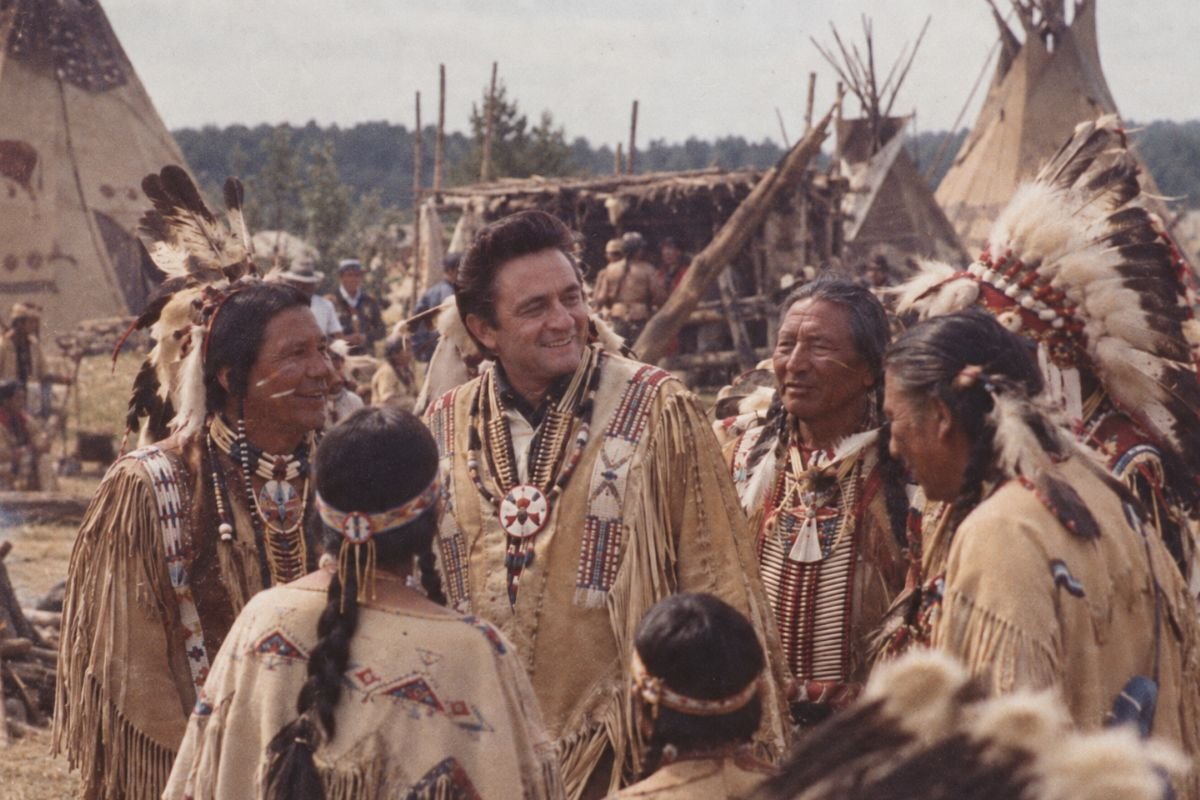
THE UNTOLD STORY OF JOHNNY CASH: HIS QUIET SUPPORT FOR NATIVE AMERICAN COMMUNITIES — BEHIND THE MUSIC AND FAME, A MAN WHO NEVER STOPPED LISTENING TO PEOPLE IN NEED
Johnny Cash is usually remembered for his deep voice, black clothing, unforgettable songs, and remarkable career. But the story of his life extends far beyond the recording studio and concert stage. Throughout his career, Cash repeatedly used his public platform to draw attention to people whose struggles were often overlooked.
Among the communities that received his attention were Native Americans, whose history, culture, and treatment in the United States became subjects that Cash increasingly explored during the later decades of his career.
Cash’s interest in these issues was not simply a passing curiosity.
He had a longstanding fascination with American history and with the people whose stories were rarely given a prominent place in popular culture. His music frequently focused on workers, prisoners, soldiers, poor families, and others living through difficult circumstances.
Native American history became another part of that larger interest.
In 1964, Cash recorded “The Ballad of Ira Hayes,” a song about the Native American Marine who became famous for his role in raising the American flag at Iwo Jima during World War II. The song told a much more complicated story than the celebrated photograph alone.
Ira Hayes was honored as a war hero, but after returning home, he struggled with life away from the battlefield and died at a young age.
Cash’s decision to record the song demonstrated his willingness to bring uncomfortable subjects into mainstream country music.
The song did not simply celebrate military heroism.
It asked listeners to consider what happened after the photographs, ceremonies, and applause were over.
That approach became characteristic of Cash.
He was interested in what happened to people once the rest of society stopped paying attention.
His support for Native American causes also appeared in his broader public advocacy. Cash spoke about Native American rights and participated in efforts intended to bring greater attention to Indigenous communities and their circumstances.
One important example was his involvement with Native American advocacy and benefit events during the 1960s and 1970s.
Cash understood the power of his name.
A musician with millions of listeners could bring attention to an issue that might otherwise receive little coverage. A song could reach people who might never read a political speech or academic study.
That was one of the unusual strengths of his career.
Cash could take a complicated subject and tell it through a human story.
Rather than speaking only in abstract terms about poverty or discrimination, he often introduced audiences to individuals.
A soldier.
A prisoner.
A farmer.
A struggling family.
A person who had been forgotten.
That storytelling approach allowed Cash to communicate with audiences across social and cultural boundaries.
His concern for people facing poverty was also deeply connected to his own upbringing.
Cash was born during the Great Depression and grew up in a poor farming family in Arkansas. His childhood experiences shaped the way he understood economic hardship.
He knew what it meant to work hard without having much money.
He knew what it meant for a family to live with uncertainty.
And he understood that circumstances beyond a person’s control could profoundly affect the opportunities available to them.
Those experiences remained visible in his music throughout his life.
This helps explain why stories about Cash quietly helping people have persisted among fans.
There is a natural consistency between the public causes he supported and the image of a man who remembered what hardship felt like.
However, claims that Cash secretly provided specific charitable assistance to particular Native American communities or personally financed educational opportunities for members of the Seneca Nation should be treated carefully unless supported by reliable documentation.
The broader historical record is clearer: Cash used his fame to raise awareness of Native American issues, recorded songs addressing Indigenous experiences, and participated in public advocacy.
The distinction matters because his real contributions are significant enough without needing an embellished legend.
Perhaps the most powerful part of his story is not the idea that he secretly solved people’s problems.
It is that he repeatedly tried to make people see them.
That was especially important during an era when mainstream entertainment often presented simplified versions of American history.
Cash’s work challenged that simplicity.
Through songs such as “The Ballad of Ira Hayes,” he encouraged listeners to think about the lives behind national symbols.
A photograph could become famous.
A ceremony could make headlines.
But the person in the photograph still had to live with the consequences of history.
Cash understood that.
His approach was also consistent with his relationship with prisoners. His legendary performances at Folsom Prison and San Quentin demonstrated his willingness to enter places that other entertainers might avoid.
He repeatedly sought out people who lived outside the comfortable center of American life.
That pattern tells us something important about the artist.
Johnny Cash’s public image was built around the Man in Black, but his deeper identity was that of a storyteller who wanted to understand people.
He did not always agree with everyone he encountered.
He did not always have the ability to change their circumstances.
But he could listen.
He could perform.
He could tell their stories.
And sometimes, he could use his enormous platform to make sure those stories reached millions of people.
That may be the most meaningful interpretation of his charitable legacy.
Generosity is not always measured by the size of a donation.
Sometimes it is measured by attention.
Who did you notice?
Whose story did you tell?
Whose suffering did you refuse to ignore?
Johnny Cash spent much of his career asking those questions through music.
His relationship with Native American history was part of that larger mission. His songs and public statements helped bring subjects such as Indigenous experiences, poverty, inequality, and forgotten veterans into conversations that reached mainstream audiences.
The impact of that work should not be reduced to a simple story of a famous musician secretly giving money away.
It was something more enduring.
He used his voice.
And for an artist whose entire career depended upon the power of a voice, that may have been his greatest gift.
Johnny Cash died in 2003, but the questions raised by his music remain.
What happens to people after the headlines disappear?
What happens to communities whose struggles receive little attention?
And what responsibility does a famous person have when they have the ability to make others listen?
Cash’s answer was often found in the songs he chose to sing.
He looked toward the forgotten.
He told their stories.
And he reminded his audience that behind every historical event was a human being with a life, a family, a struggle, and a story worth remembering.
That is perhaps the quieter legacy behind the legend of Johnny Cash.
Not simply the records he sold or the awards he received, but the moments when he used his fame to direct attention toward people who might otherwise have remained invisible.
The Man in Black became famous because millions listened to his voice. His lasting legacy may be that he spent much of that voice asking the world to listen to others.