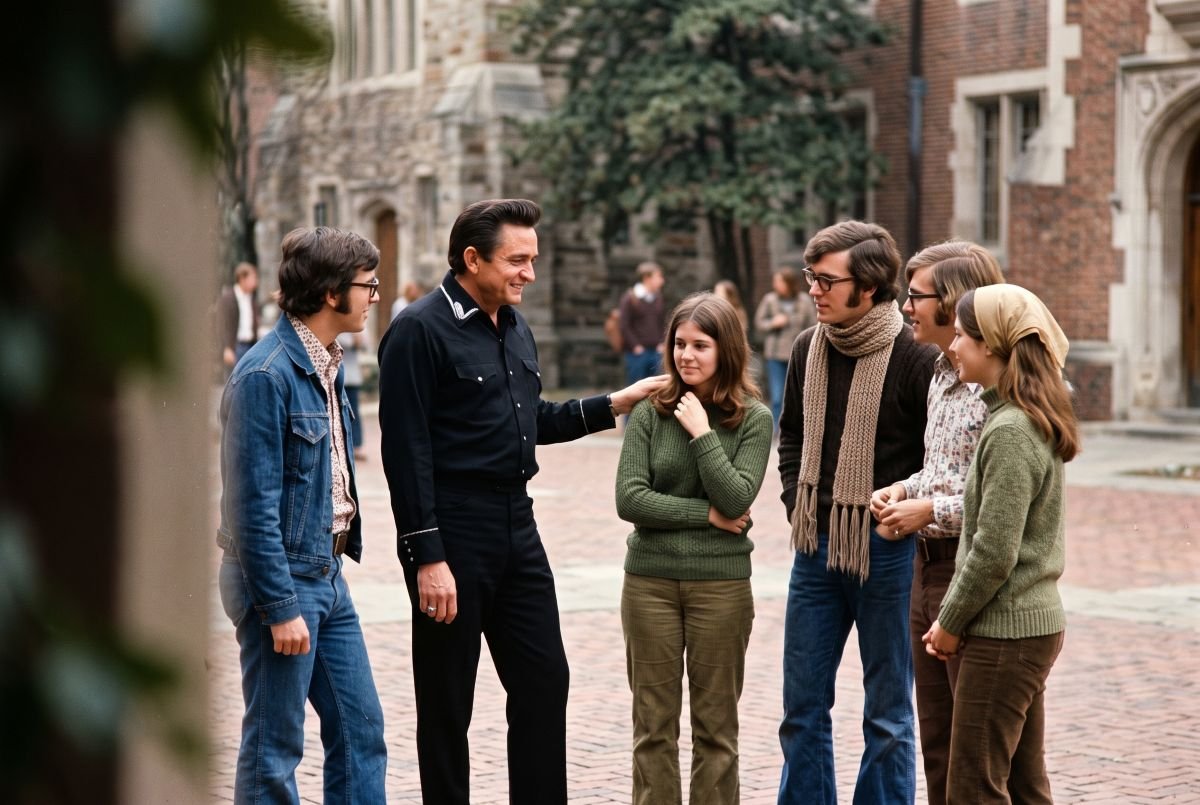
THE HEARTBREAKINGLY HUMBLE STORY: JOHNNY CASH AND THE QUIET GENEROSITY OF A MAN WHO NEVER FORGOT WHERE HE CAME FROM
Long before Johnny Cash became known around the world as The Man in Black, he was a boy growing up in the small agricultural community of Dyess, Arkansas. His family was poor, life was demanding, and every member of the household understood the value of hard work.
Those early experiences never completely left him.
Even after Cash became a legendary musician, sold millions of records, performed before enormous audiences, and accumulated wealth that would have been unimaginable during his childhood, he continued to speak about the people and places that shaped him. Dyess was more than a location in his biography. It was part of the foundation of who Johnny Cash became.
That is why stories about Cash quietly helping people from humble backgrounds have continued to capture the imagination of his fans.
Among the most touching versions is the story of Cash helping the children of struggling farming families pursue an education. The tale has often been repeated as an example of his generosity, with some accounts claiming that he secretly paid college tuition for five children of poor farmers in Dyess and asked that no one publicize what he had done.
Whether every detail of that particular story can be independently documented is difficult to establish. But the larger picture of Cash’s life reveals something important: helping ordinary people was consistent with the values he frequently expressed throughout his career.
Cash never forgot what it meant to grow up without much money.
He was born in 1932, during the Great Depression, and his family eventually moved to the Dyess Colony as part of a federal resettlement program. The Cash family lived and worked on a small farm, where daily life demanded discipline and perseverance.
The young Johnny experienced hardship firsthand.
His family worked the land. They dealt with financial uncertainty. They experienced personal tragedy. These experiences later became part of the emotional foundation of his songwriting.
Cash’s music repeatedly returned to the lives of working people and families struggling to get by.
He sang about farmers, laborers, prisoners, soldiers, travelers, and people who had been pushed toward the edges of society. His ability to tell their stories was one of the reasons his music connected with such a wide audience.
He understood those people because he had once been one of them.
As his career grew, Cash’s circumstances changed dramatically. Fame brought financial security, but he continued to identify strongly with the values of his childhood.
That was especially evident in his relationship with Dyess.
Cash eventually became one of the most famous people ever to come from the small Arkansas community. Yet he continued to talk about his childhood there and the people he had known.
His connection to the community helped preserve an important part of his identity: before the concerts, television appearances, awards, and international recognition, there had been a boy on an Arkansas farm.
That memory mattered.
It helps explain why stories of quiet generosity have become such an enduring part of the Cash legend. Whether he was supporting prisoners, encouraging struggling musicians, visiting hospitals, helping individuals facing difficult circumstances, or speaking publicly about people society often overlooked, Cash repeatedly demonstrated an interest in human stories rather than simply celebrity status.
He was particularly drawn to people who needed someone to listen.
The alleged tuition story fits naturally within that broader image.
Imagine what a college education could mean to a child from a family struggling to survive through farming. Tuition is not merely a financial expense. It can represent an opportunity to change the direction of an entire life.
For a young person with ability but limited resources, financial assistance can mean the difference between postponing education and actually attending college.
That is why the story has such emotional appeal.
And the supposed request for privacy makes it even more powerful: “Don’t tell anyone.”
Whether those exact words were spoken cannot be confidently established without a reliable primary source. Still, the idea reflects a philosophy often associated with meaningful acts of generosity—the notion that helping someone does not always need to become a public performance.
Cash certainly understood publicity. He lived much of his adult life in front of cameras, microphones, journalists, and enormous audiences.
Yet some of the most meaningful moments in a person’s life happen away from the spotlight.
There is something fitting about that contrast.
The world knew Johnny Cash as a towering musical figure. But the people who knew him personally often remembered the man behind the image: a son, a brother, a father, a neighbor, and a person who remembered hardship.
His fame never changed the fact that he had once known what it felt like to have very little.
Perhaps that is why education, opportunity, and helping young people could carry such emotional significance in stories about his generosity.
Cash knew that talent alone does not guarantee opportunity.
Circumstances matter.
Family finances matter.
Access to education matters.
And sometimes, one person’s assistance can open a door that might otherwise remain closed.
The most important lesson in this story, therefore, is not whether every detail of the popular account can be confirmed. It is the broader principle behind it: Johnny Cash understood the importance of remembering where you came from.
His greatest songs often carried that same message.
Success should not require forgetting the people who helped shape you. Wealth should not erase memories of hardship. And fame should not make ordinary people invisible.
Cash’s life contained contradictions and difficulties, just like anyone else’s. He was not a flawless man, and his biography includes painful chapters alongside the extraordinary achievements.
But his connection to people who struggled remained one of the most recognizable features of his public legacy.
That is why the image of Johnny Cash quietly helping a young person pursue an education feels so powerful.
It brings the legendary musician back to the place where his story began.
Dyess.
A small Arkansas community.
A childhood shaped by hard work.
A family that knew the meaning of sacrifice.
And a young boy who could never have imagined that one day the world would know his name.
Perhaps the most beautiful way to remember Johnny Cash is not simply as the famous singer who stood beneath the lights.
It is to remember the ordinary human being behind the legend—the man who knew what hardship felt like and who, throughout his life, repeatedly expressed concern for people who were struggling.
Fame made Johnny Cash famous.
But remembering where he came from helped keep him connected to the people whose stories had shaped his music.
And that may be the quietest part of his legacy:
Sometimes the most meaningful generosity is not the act that everyone sees. It is the hand extended when there is no audience, no applause, and nothing to gain except knowing that another person has been given a chance.
VIDEO