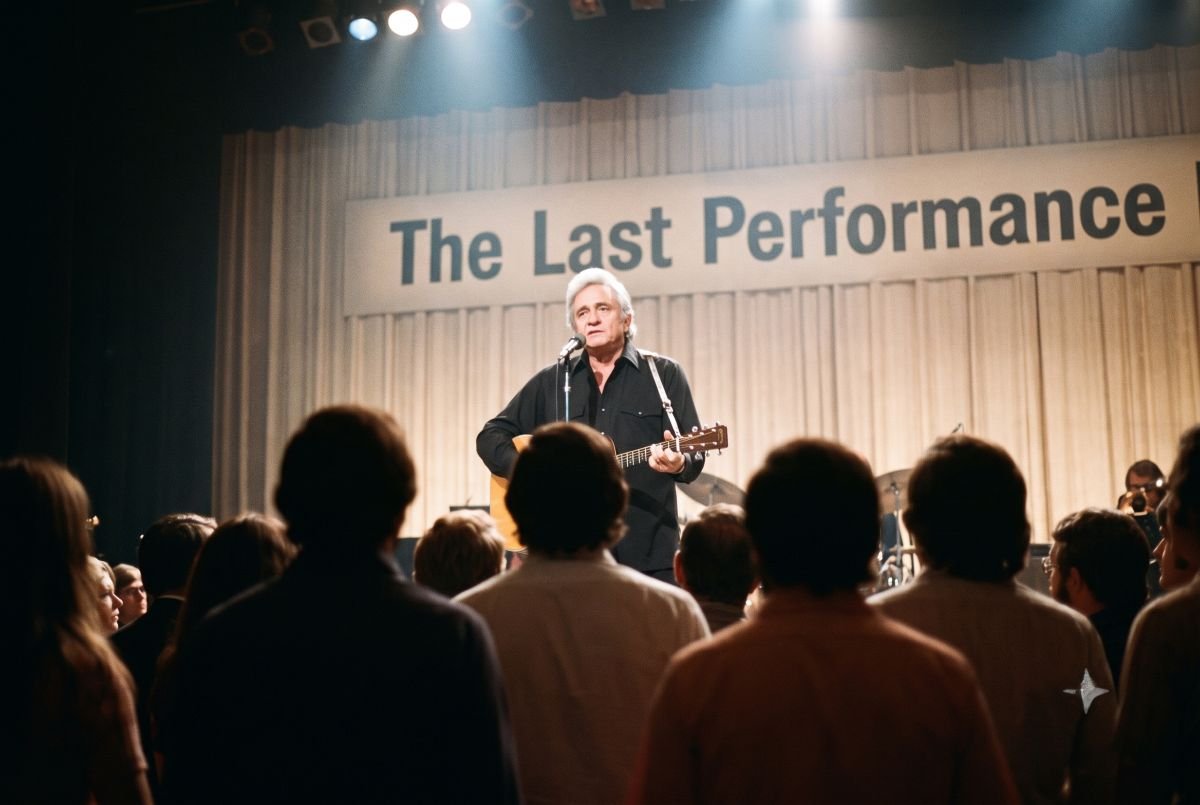
A DEEPLY EMOTIONAL REVELATION: JOHNNY CASH’S FINAL YEARS, HIS FRAGILE BREATHS, AND THE HAUNTING STORY BEHIND “HURT” — A POWERFUL LAST CHAPTER THAT TRANSFORMED A SONG OF PAIN INTO AN UNFORGETTABLE MUSICAL FAREWELL
There are performances that entertain us, performances that impress us, and performances that seem to reveal something far deeper about the person standing before us. Johnny Cash’s recording of “Hurt” belongs to the last category.
When Cash recorded the song in 2002, he was an elderly man whose health had become increasingly fragile. He had already lived through extraordinary triumphs, personal losses, years of struggle, and a career that had carried him from small stages to international fame. By then, his voice sounded different from the one audiences had heard decades earlier.
It was quieter.
It was rougher.
And somehow, that made it feel even more powerful.
Originally written and recorded by Nine Inch Nails songwriter Trent Reznor in 1994, “Hurt” was never written specifically for Johnny Cash. Yet when producer Rick Rubin suggested that Cash record it, something unexpected happened. The song took on a completely different emotional meaning when placed in Cash’s voice.
The transformation was not simply musical.
It was personal.
Cash was nearing the end of his life. He had experienced the deaths of people close to him, faced serious health challenges, and watched the world around him change dramatically. He had also spent decades examining themes of regret, faith, mortality, redemption, and loneliness through his music.
“Hurt” brought many of those themes together.
The recording took place during the period when Cash was making the American Recordings albums with Rubin. These records stripped away much of the elaborate production associated with mainstream music and placed Cash’s voice and storytelling at the center.
There was no need for a grand arrangement.
There was no need for spectacle.
There was simply Johnny Cash and the weight of the words.
The opening is deliberately restrained. His voice sounds vulnerable, almost as though every line requires effort. The effect is startling because Cash had once been known for his commanding baritone and powerful stage presence.
Now, he sounded like a man looking backward.
The music video intensified that impression.
Released in 2003, the video combined images from Cash’s life and career with footage of him performing the song. His face appeared older and more fragile than the legendary photographs of his younger years. Images of his past were placed beside scenes from his present, creating a striking contrast between youth and age, fame and solitude, memory and mortality.
The emotional response was immediate.
Many listeners who had never paid particular attention to Nine Inch Nails suddenly discovered “Hurt” through Cash. Others who already knew the original heard the song differently because Cash brought decades of personal history into every phrase.
Trent Reznor himself later acknowledged the extraordinary impact of Cash’s version, describing it as something that gave him a perspective on the song that he had not previously considered.
That is one of the most remarkable aspects of the recording.
Cash did not simply cover “Hurt.”
He reinterpreted it.
The original song emerged from a much younger perspective. Cash’s version carried the perspective of someone who had spent an entire lifetime accumulating memories. The words were no longer heard simply as the expression of youthful despair. In Cash’s hands, they became part of a meditation on an entire life.
By this stage, Cash’s health was deteriorating.
He had been living with significant medical problems, including autonomic neuropathy associated with diabetes, and he experienced other health difficulties over the years. His physical condition affected his ability to perform, but he continued recording whenever he could.
The passing of June Carter Cash in May 2003 was another devastating blow. June had been his wife, musical partner, and one of the most important people in his life. Her death profoundly affected him.
Cash continued working afterward, but those final months carried an unmistakable sense of loss.
When audiences watched the “Hurt” video, many interpreted it as a kind of farewell. The imagery, the aging face, and the haunting performance seemed to capture a man confronting the end of his journey.
It became difficult to separate the song from the circumstances surrounding it.
Yet it is important to remember that “Hurt” was not originally written as Cash’s final statement. Its meaning grew from the combination of Reznor’s writing, Cash’s interpretation, Rubin’s production, and the circumstances of Cash’s later life.
That complexity is part of what makes the recording so enduring.
Johnny Cash died on September 12, 2003, at the age of 71, only a few months after June.
His passing marked the end of one of the most remarkable careers in American music. But the recording of “Hurt” ensured that one of his final creative chapters would continue to reach audiences long after his death.
The song became more than a recording.
It became a reflection.
People heard in Cash’s voice their own memories of aging, loss, mistakes, family, regret, and the passage of time. The song did not provide easy answers. Instead, it created a space for listeners to confront difficult emotions honestly.
That may be the greatest strength of Cash’s final performance.
He did not try to hide the signs of age.
He did not pretend that life had been perfect.
He simply stood before the microphone and sang with the voice of someone who had lived through an extraordinary number of chapters.
The young Johnny Cash had once sung about trains, prisons, working people, faith, and restless lives. The older Cash was now singing about something even more universal: what it means to look back and ask what remains when the noise finally fades.
That is why “Hurt” continues to feel so haunting.
It represents the meeting of two artists, two generations, and two very different perspectives on pain. Trent Reznor created the song, but Johnny Cash gave it a new emotional identity.
And perhaps that is the most unforgettable part of the story.
A song written decades earlier found an entirely new meaning in the voice of an aging legend. Near the end of his life, Cash transformed it into something that sounded less like a performance and more like an intimate reflection.
His final years were marked by physical limitations and profound personal loss, but they also produced some of the most emotionally revealing music of his career.
Johnny Cash left the world in 2003.
But his voice did not disappear.
It remains in the recordings, the stories, and the songs that continue to introduce new generations to The Man in Black.
And whenever “Hurt” begins to play, listeners hear more than an old song.
They hear a lifetime compressed into a few minutes—a voice growing fragile, a man looking backward, and an artist leaving behind a final emotional imprint that continues to echo long after his final days.