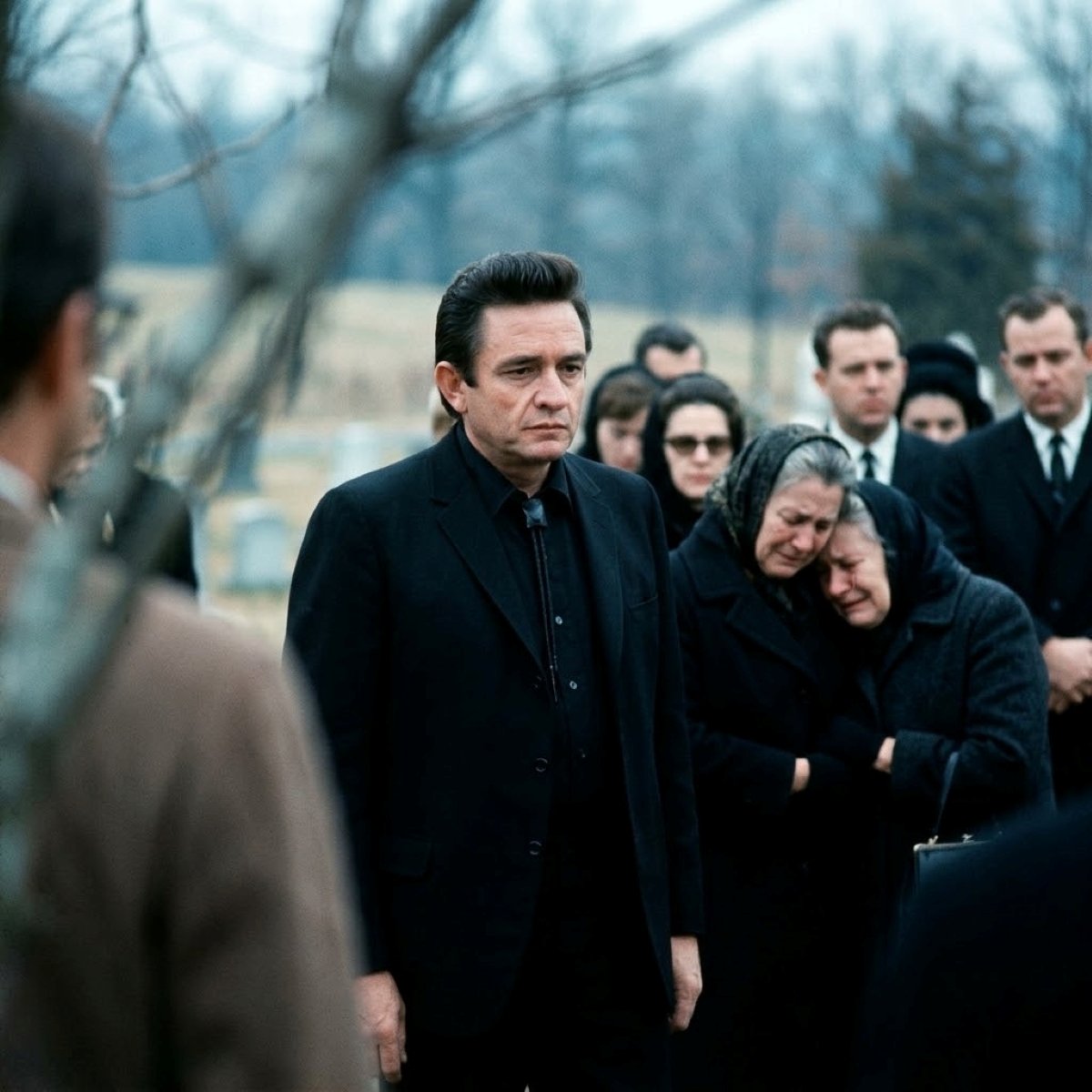
A HEARTBREAKING TRUTH: A DESPERATE MOTHER’S PAINFUL LETTER TO JOHNNY CASH — HER FINAL PLEA FOR HELP, THE QUIET PROMISE HE NEVER FORGOT, AND HIS SILENT PRESENCE AT THE FUNERAL OF SOMEONE THE WORLD HAD ALMOST FORGOTTEN
There are stories in music history that are remembered because of fame, fortune, and extraordinary success. And then there are stories remembered for something much quieter: one person refusing to forget another.
Johnny Cash became famous for his deep voice, powerful songs, and unforgettable presence on stage. But behind the public image was an artist who repeatedly showed an interest in people whose stories might otherwise have disappeared without a trace. One of the most poignant examples involves a struggling family, a desperate appeal for help, and the complicated story surrounding Glen Sherley, the Folsom Prison inmate whose song “Greystone Chapel” reached Cash before his release.
The story begins not with a concert, but with a plea for compassion.
Glen Sherley had spent years behind prison walls. During that time, music became an important outlet for him. He wrote songs that reflected his experiences, his hopes, his regrets, and his desire to build a different life. Among those songs was “Greystone Chapel,” inspired by the chapel at Folsom Prison.
For someone inside an institution, having a song heard beyond those walls could seem almost impossible.
Then Johnny Cash heard it.
Cash performed “Greystone Chapel” during his historic 1968 concert at Folsom Prison, bringing Sherley’s words to an audience far beyond the prison itself. The performance helped introduce the songwriter to the outside world and became part of Cash’s landmark At Folsom Prison album.
But Cash’s connection with Sherley did not end with that performance.
After Sherley was released on parole in 1971, Cash supported his efforts to pursue a career in music. He offered encouragement and opportunities, helping him navigate a world that was completely different from the one he had known inside prison.
For Sherley, this represented something precious: the possibility of starting again.
Yet the transition proved difficult.
A person can walk through a prison gate and still carry years of emotional and practical challenges with them. Freedom does not automatically erase the past. Building a new life requires stability, support, and time.
Sherley’s story eventually became increasingly troubled, and his relationship with Cash also experienced difficulties. Their professional association did not develop into the lasting success that many had hoped for.
Then came the devastating news.
In 1978, Glen Sherley died by suicide, leaving behind a painful story of promise, struggle, and loss.
Accounts of what happened afterward have varied, and some versions of the story have become embellished over the years. That makes it important to separate documented events from later retellings.
What can be said with greater confidence is that Sherley had once been given something he desperately needed: someone willing to hear him.
Johnny Cash had encountered him when he was largely unknown outside Folsom Prison. He had heard his song and recognized its value. He had helped bring that song to a much larger audience and later supported Sherley’s attempt to establish himself after release.
That does not mean Cash could control Sherley’s future.
It does not mean one person’s kindness could overcome every difficulty.
But it does mean that Cash’s actions reflected a consistent theme throughout his career: people should not be forgotten simply because their lives have taken painful turns.
This is what makes stories about Cash and prisoners so compelling.
He did not present himself as someone who had all the answers. Instead, he often approached people with curiosity and empathy. His songs were filled with characters who had made mistakes, suffered losses, or found themselves separated from the rest of society.
He understood that behind every prison number was a human story.
The emotional power of the Sherley story therefore comes from more than the tragedy of its ending. It comes from the extraordinary contrast between being forgotten and being heard.
One moment, Sherley was a prisoner whose songwriting was known mainly within Folsom.
Then Johnny Cash sang his song.
Suddenly, his words traveled far beyond the prison chapel that had inspired them.
For a short time, the outside world knew his name.
His story reminds us that recognition can be profoundly meaningful to someone who has spent years feeling invisible. A song can become a doorway. A conversation can become encouragement. A gesture of trust can give a person hope that tomorrow might be different.
But human lives are rarely that simple.
Even sincere friendship cannot remove every obstacle. Even a second chance can be difficult to navigate. And sometimes, despite the efforts of people who care, the ending remains heartbreaking.
That is why the story should not be reduced to a simple tale of a celebrity “saving” a forgotten man.
Its deeper meaning lies elsewhere.
It is about what happens when someone chooses to listen.
Johnny Cash’s legacy was built partly on his music, but it was also shaped by the people he encountered along the way. His relationship with Glen Sherley remains a complicated and deeply human chapter in that legacy.
“Greystone Chapel” began as a song written by a man behind prison walls. Johnny Cash gave it a stage. The song then became part of one of the most famous live recordings in country music history.
Years later, Sherley’s life ended tragically.
Yet his name did not completely disappear.
His music survived.
His story survived.
And because Johnny Cash stopped long enough to listen, the world was given an opportunity to know that Glen Sherley had once been there, had something to say, and had dreams of a different life.
Perhaps that is the quiet lesson hidden inside this heartbreaking story.
We cannot always change another person’s destiny. We cannot promise that every struggle will have a happy ending. But we can choose whether to look away or listen.
Johnny Cash listened.
And for someone who had spent years being overlooked, being heard may have been one of the most meaningful gifts anyone could give.