A DEEPLY MOVING REVELATION: JOHNNY CASH’S PERFORMANCE OF “GREYSTONE CHAPEL” AT THE FOLSOM SHOW — FROM GIVING A FORGOTTEN PRISONER A VOICE AND A SECOND CHANCE TO STANDING BY HIS SIDE IN HIS FINAL DAYS
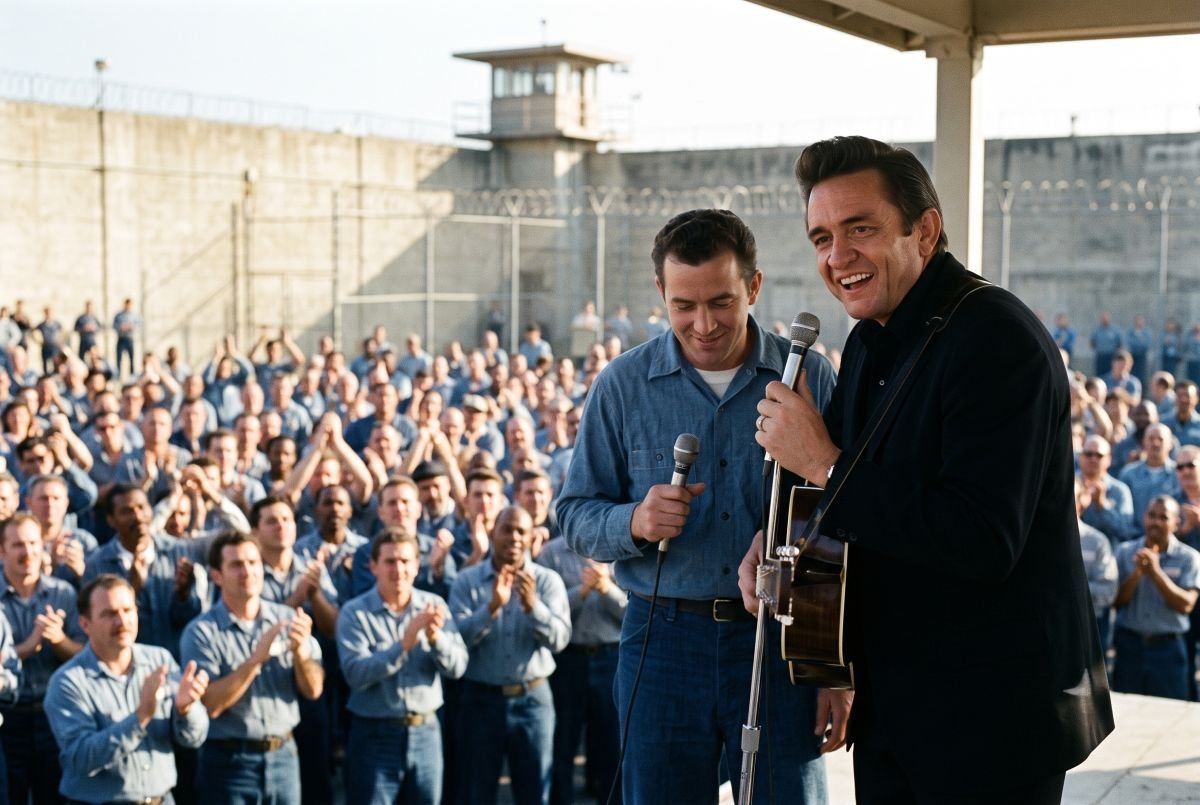
On a January morning in 1968, Johnny Cash walked onto a stage inside California’s Folsom Prison and performed before hundreds of incarcerated men. The concert would eventually become one of the most celebrated live performances in music history. But among the songs he performed that day was one with a story far more personal than many listeners realized: “Greystone Chapel,” written by Folsom inmate Glen Sherley.
The story behind that song would lead to an unexpected friendship, a remarkable opportunity, and a painful chapter that remained with Cash for years.
Johnny Cash had long been fascinated by the lives of people behind prison walls. His interest was not merely artistic. He wanted to understand their stories and remind his audience that people in prison were still human beings with memories, regrets, hopes, and dreams.
His famous song “Folsom Prison Blues” had already established a connection between Cash and the world of incarceration. When he finally performed at Folsom Prison on January 13, 1968, he entered a place that had inspired some of his most recognizable music.
But Cash arrived with no expectation that the concert would introduce him to one of the most important personal relationships of his later career.
That connection began with Glen Sherley.
Sherley was serving a sentence at Folsom Prison and had written a song called “Greystone Chapel.” The composition was inspired by the prison chapel and reflected Sherley’s thoughts about faith, confinement, and the possibility of hope.
The song might easily have remained within the prison walls.
Instead, shortly before Cash’s performance, a recording of “Greystone Chapel” reached people connected with the singer. Cash heard it and decided to include the song in his Folsom performance.
The moment was extraordinary.
A prisoner who had spent years largely unknown outside the institution suddenly heard his own words being performed by Johnny Cash himself.
Cash’s decision gave Sherley’s songwriting a national platform and helped transform the song from a private expression into part of a historic musical event.
The performance was later included on the legendary At Folsom Prison album, released in 1968. The record became a major success and helped redefine Cash’s public image as an artist willing to bring attention to people living on the margins of society.
But Cash’s interest in Sherley did not end when the concert was over.
The two developed a relationship that went beyond a singer performing another man’s song. Cash became an important supporter of Sherley and believed that his songwriting talent deserved an opportunity outside prison.
When Sherley was released on parole in 1971, Cash helped him enter the professional music world. For someone who had spent years behind bars, the opportunity represented an extraordinary change.
Sherley was given access to musicians, recording opportunities, and audiences that would previously have been unimaginable.
Cash was, in effect, offering him a second chance.
The story, however, was not a simple success story.
Life after incarceration brought challenges that could not be solved simply by opening a door to the music industry. Sherley struggled with the transition, and his relationship with Cash eventually became complicated. Their professional association did not develop as either man may have hoped.
Yet the earlier act of compassion remained significant.
Cash had seen a songwriter whom much of the outside world had never heard of and decided that his work deserved attention.
He believed that a person’s past did not necessarily have to determine everything that came afterward.
That idea appeared repeatedly throughout Cash’s career. He often sang about redemption, loneliness, mistakes, forgiveness, and the possibility of change. His connection with prisoners was part of a larger belief that people should not be reduced to the worst thing they had ever done.
Unfortunately, Sherley’s later life became increasingly difficult.
In 1978, Glen Sherley died by suicide at the age of 42. His death brought a tragic end to a life that had briefly moved from prison obscurity to national attention.
The tragedy has sometimes been retold in simplified ways, as though Johnny Cash alone could have saved Sherley. The reality was more complicated. No friend can control another person’s struggles, and offering someone a second chance cannot guarantee that their difficulties will disappear.
What Cash did provide was friendship, encouragement, and opportunity.
That distinction matters.
The story of “Greystone Chapel” is powerful not because it has a perfectly happy ending, but because it reveals how one human being chose to listen to another when many others might have ignored him.
Cash heard a song written behind prison walls.
He recognized something in it.
He performed it.
Then he tried to help the person who had written it build a different future.
For a brief period, Sherley moved from being an almost forgotten prisoner to becoming a songwriter whose work had been heard by millions.
And that began with one remarkable moment at Folsom.
There is something deeply moving about imagining Sherley inside the prison, knowing that his song was being sung on stage by one of the most famous musicians in America. “Greystone Chapel” was no longer simply his private creation. It had become a bridge between two worlds.
Cash stood on one side of that bridge as a celebrated performer.
Sherley stood on the other as a prisoner hoping that his music might somehow reach beyond the walls.
For a few precious moments, music connected them.
Years later, the story would become more painful, but the significance of that connection did not disappear.
Johnny Cash could not rewrite Sherley’s entire life. He could not erase the years of hardship or guarantee what would happen after release. But he could—and did—recognize his humanity.
That is perhaps the deepest meaning behind “Greystone Chapel.”
It is not only a song about a prison chapel.
It is a story about what can happen when someone who feels forgotten is finally heard.
It is about compassion without judgment, friendship in unexpected places, and the belief that a person’s future can contain possibilities beyond their past.
Johnny Cash gave Glen Sherley a microphone when almost no one outside Folsom knew his name. He helped open a door that had previously seemed closed.
The ending of Sherley’s story was heartbreaking. But the beginning of their friendship remains a reminder that even a single act of recognition can leave a lasting mark.
Sometimes, a second chance does not change everything.
Sometimes, it simply gives someone a moment in which they know that someone believed their voice mattered.
And that is why, decades later, the story behind “Greystone Chapel” remains one of the most poignant chapters in Johnny Cash’s remarkable life.